

In our previous article, we explored how a simple shipping code difference can stop an order from moving through an otherwise successful integration. If you haven’t read it yet, we recommend starting with , where we explain why shipping code mapping is essential to keeping orders moving across connected systems.
For many businesses, solving shipping code differences is straightforward. When two systems use different values for the same shipping service, you simply create a mapping between them.
For a while, that works well.
The challenge begins as the business grows.
A second marketplace is added. Then another warehouse. A 3PL. A new retailer. Before long, what started as a handful of shipping code mappings has turned into dozens—or even hundreds—of mapping rules maintained across different integrations.
At that point, shipping code mapping is no longer the problem.
Managing those mappings is.
Shipping Code Mapping Doesn’t Stay Simple for Long
A supplier selling exclusively through Amazon Vendor Central might only need a few shipping code mappings between Amazon and its warehouse management system. Every incoming shipping method has a corresponding value, and the integration works exactly as expected.
As the business expands, however, that simple relationship quickly becomes more complicated.
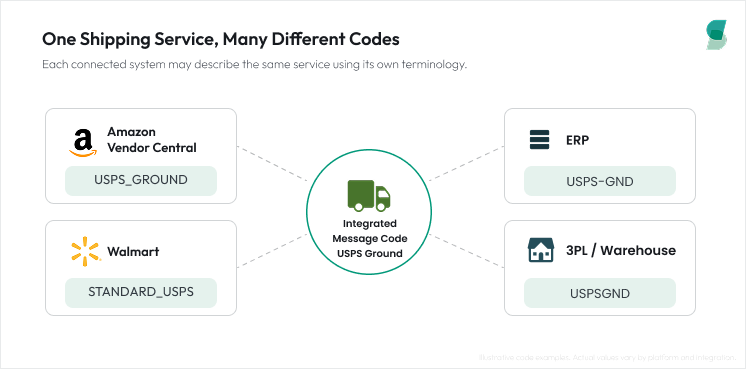
Walmart may use different shipping method names. A 3PL may identify carrier services using its own internal codes. An ERP system may store those same services differently again, while additional retailers introduce entirely new naming conventions and operational requirements.
None of these systems are incorrect. Each was designed independently to support its own workflow.
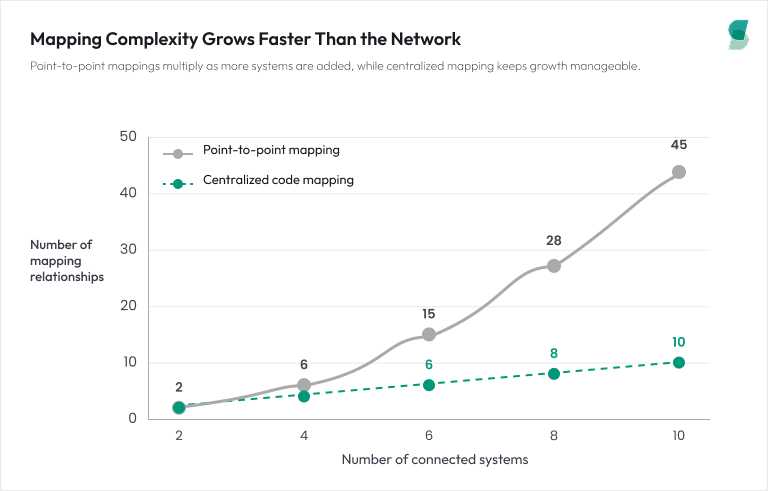
The difficulty is that every new connection introduces another relationship that has to be maintained. What was once a small configuration gradually becomes an expanding network of mappings spread across multiple systems.
The integrations themselves continue to work. The operational complexity grows around them.
The Real Challenge Isn’t Creating Mappings—It’s Keeping Them Consistent
Many growing businesses don’t notice this shift immediately.
Each time a new marketplace or logistics partner is added, another mapping table is created.
When a warehouse changes a carrier code, someone updates the corresponding integration. If another retailer uses a different shipping method, another rule is added.
None of these changes are particularly difficult on their own.
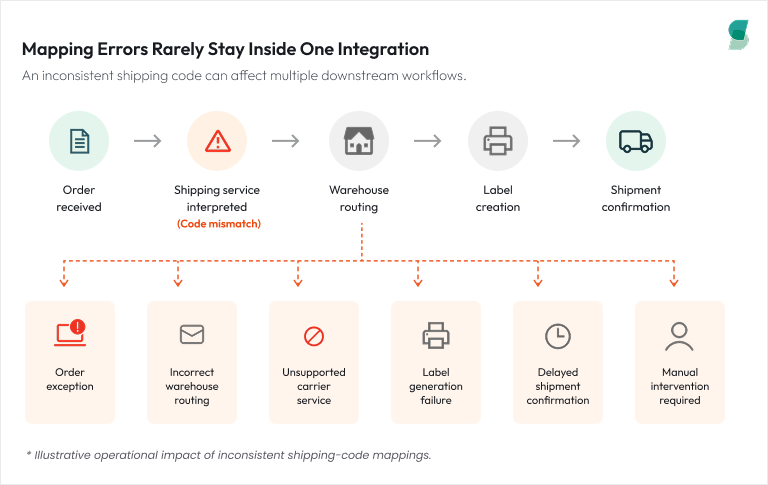
Over time, however, the mappings become scattered. Different integrations maintain their own configuration, updates are applied in one place but forgotten in another, and operational knowledge gradually becomes dependent on the people who remember why a particular mapping exists.
When fulfillment exceptions appear, the root cause often isn’t a broken integration. It’s an outdated or inconsistent mapping that no one realized had fallen out of sync.
This is why shipping code management becomes an operational challenge long before it becomes a technical one.
Growing Businesses Need a Single Source of Truth
As integration networks become larger, maintaining mappings independently becomes increasingly difficult.
Rather than managing shipping codes separately for every marketplace, warehouse, ERP system, and logistics provider, mature integration platforms centralize those mappings into a shared reference that every connected workflow can use.
Instead of asking every system to understand every other system’s terminology, each system only needs to understand one consistent internal reference.
This approach offers several practical advantages.
New partners can be added without redesigning existing integrations. Operational changes are made once instead of repeated across multiple systems. Most importantly, teams gain confidence that every connected workflow is using the same business logic, regardless of where an order originated or where it will be fulfilled.
Shipping code mapping no longer grows linearly with the business.
It becomes something the platform manages consistently.
How Synctify Centralizes Shipping Code Management
At Synctify, we solve this challenge through Integrated Message Codes(IMC).
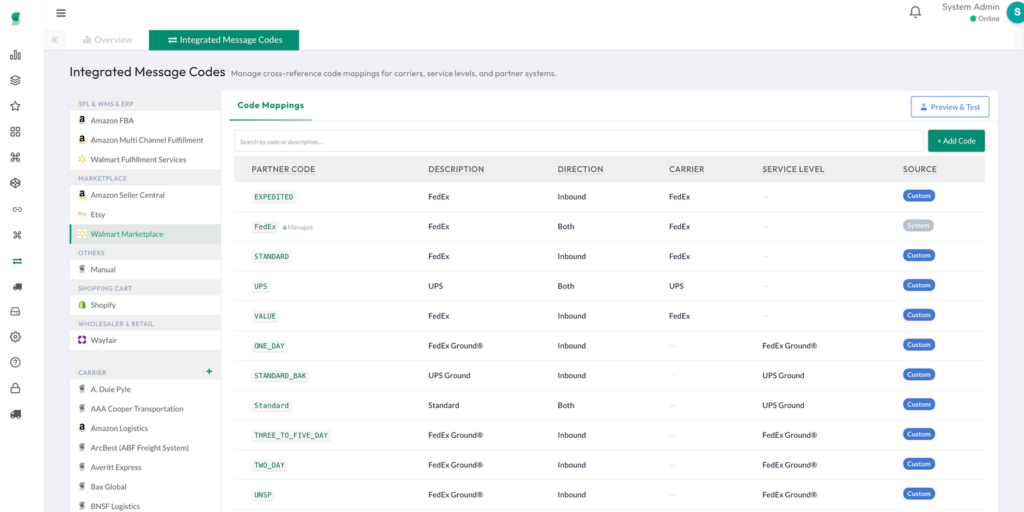
Rather than embedding shipping code mappings inside individual integrations, IMC provides a centralized repository where operational values are standardized and shared across connected systems.
For example, Amazon Vendor Central, Walmart, a warehouse management system, and a 3PL may all describe the same shipping service differently. Instead of maintaining separate mapping rules for every relationship, each system is mapped once to a common internal message code. Every integration then references that shared definition.
When a new marketplace or fulfillment partner is added, businesses don’t have to rebuild the entire mapping structure. They simply teach Synctify how the new partner represents existing shipping services while the rest of the integration network continues operating exactly as before.
The result is an integration environment that becomes easier to maintain as the business grows, rather than more difficult.
Shipping Code Mapping Is Really About Scalability
Shipping code mapping is often introduced as an integration configuration task.
In reality, it’s a scalability challenge.
Most businesses can successfully create a few mapping rules. The real test comes months or years later, when those rules have multiplied across marketplaces, warehouses, ERP systems, carriers, and logistics providers.
The companies that scale successfully aren’t necessarily the ones with the most integrations.
They’re the ones with a sustainable way to manage the operational rules behind those integrations.
Because as ecommerce operations continue to grow, shipping code mapping isn’t just about connecting systems.
It’s about keeping every connected system aligned.
Growing Your Integration Network?
As your business adds new marketplaces, warehouses, and fulfillment partners, shipping code mappings shouldn’t become harder to manage.
Whether you’re evaluating a new integration strategy or looking to simplify your existing workflows, we’re happy to help.
👉 Book a demo with our team to see how Synctify centralizes shipping code management, or reach out to your Synctify account manager to discuss your current integration environment.
FAQ
blog-how-shipping-code-mapping-breaks-at-scale
Shipping code mapping becomes more complex as businesses connect additional marketplaces, warehouses, ERP systems, and logistics providers. Each new system introduces its own shipping method names and operational rules, increasing the number of mappings that must be maintained.
No.
APIs transfer data between systems, but they don’t standardize how different systems describe shipping services. Businesses still need mapping rules to ensure that connected systems interpret shipping methods consistently.
Shipping code mapping focuses on matching shipping methods or service levels between systems, while carrier code mapping typically refers to standardizing carrier identifiers. In practice, growing ecommerce operations often need to manage both together as part of a broader fulfillment integration strategy.
Businesses should consider centralizing shipping code management when they operate across multiple marketplaces, warehouses, ERP systems, or third-party logistics providers. A centralized approach reduces duplicate mapping rules, simplifies maintenance, and makes future integrations easier to manage.
Synctify uses Integrated Message Codes (IMC) to centralize shipping code management. Rather than maintaining separate mapping rules for every integration, IMC provides a shared internal reference that allows connected systems to interpret shipping methods consistently while preserving each partner’s preferred terminology.
Subscribe to Our Newsletter
Get the latest releases, news and more!