

US ecommerce is becoming more concentrated—but that does not mean channel strategy is becoming simpler.
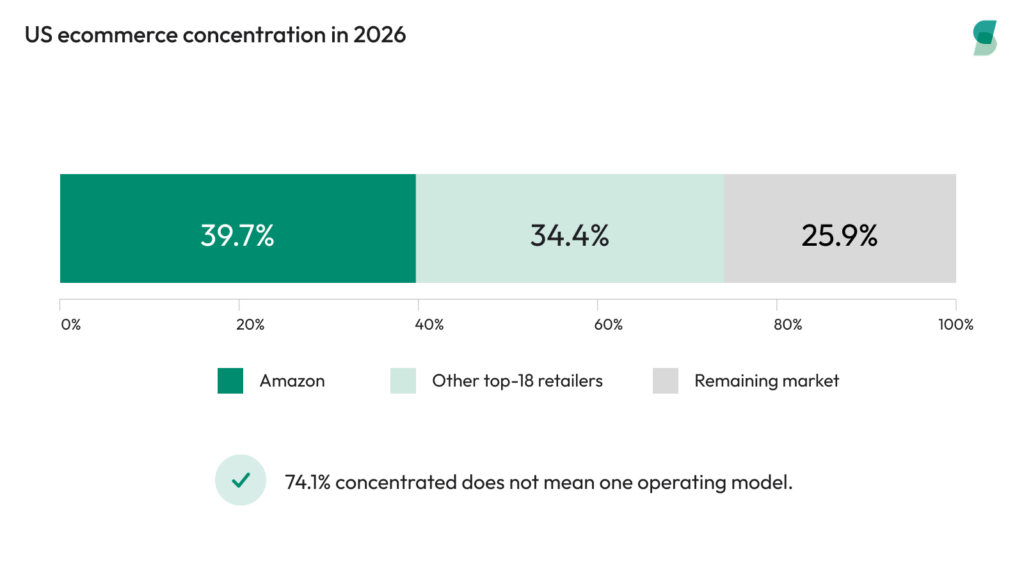
According to EMARKETER’s July 2026 forecast, the 18 largest ecommerce retailers will generate 74.1% of US retail ecommerce sales this year. Amazon alone will account for 39.7%. (EMARKETER)
The obvious conclusion is that suppliers should focus on the biggest platforms.
The more useful conclusion is that suppliers need to become much more selective about which large platforms they pursue.
Almost 60% of US ecommerce still takes place outside Amazon. But that demand is not spread evenly across hundreds of interchangeable channels. It is increasingly concentrated among a relatively small group of retailers—including Walmart, category specialists, membership retailers, home improvement chains, and retailer-owned marketplaces.
For suppliers, the question is no longer simply whether to pursue a multichannel retail strategy. It is how to identify the channels that create genuinely incremental and profitable demand.
A Concentrated Market Still Has Multiple Operating Models
The US ecommerce market is concentrated, but it has not converged around one way of doing business.
A supplier working with Amazon Vendor Central may receive wholesale purchase orders and follow retailer-specific acknowledgment, routing, shipment, and invoicing requirements.
The same supplier may operate as a third-party marketplace seller on Walmart, fulfill dropship orders for a home improvement retailer, and receive different packing or label requirements from Wayfair.
These channels may all generate “online sales,” but they do not create the same economics or operational workload.
That is why the strategic unit should not be “Amazon versus everyone else.” It should be the shortlist of retailers that matter within a supplier’s category.
For a home furnishings company, that shortlist may include Amazon, Walmart, Wayfair, Home Depot, and Lowe’s. For a grocery or consumer goods supplier, the relevant combination could look completely different.
A strong multichannel retail strategy for suppliers is therefore not about being present everywhere. It is about choosing the smallest channel portfolio that provides meaningful market coverage.
Market Growth Does Not Make Every Channel Attractive
US online retail continues to grow faster than retail overall.
The US Census Bureau reported that seasonally adjusted ecommerce sales reached $326.7 billion in the first quarter of 2026, an increase of 9.8% from a year earlier. Ecommerce represented 16.9% of total US retail sales, while total retail sales grew by 3.9% over the same period. (Census.gov)
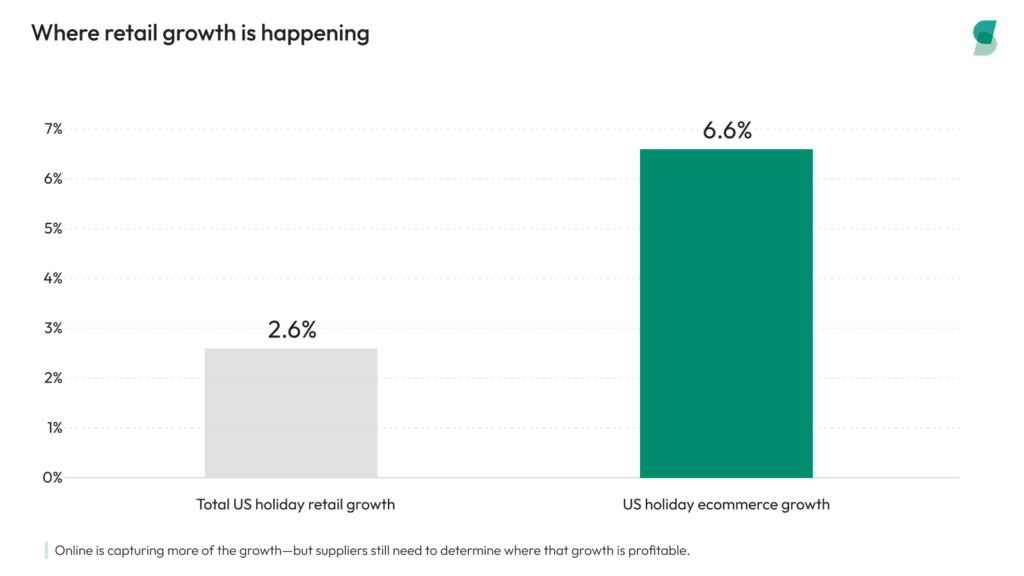
The same gap is expected during the holiday season. EMARKETER forecasts approximately 6.6% growth for holiday ecommerce in 2026, compared with 2.6% for total holiday retail. (EMARKETER)
More retail growth is moving online. But it will not necessarily move to the same platform—or create the same opportunity for every supplier.
A large marketplace may offer more traffic, but also require higher advertising spend. A smaller category retailer may generate lower order volume but provide stronger margins, better customer alignment, or a more valuable wholesale relationship.
The next channel should therefore be selected based on the source and quality of incremental demand, not market share alone.
Evaluate Real Channel Value, Not Just GMV
Most channel evaluations begin with a sales forecast:
- How much traffic does the platform have?
- How large is the category?
- What annual GMV could the channel generate?
Those questions matter, but they are not enough.
A new retail channel may increase revenue while also increasing advertising costs, fulfillment expenses, deductions, inventory fragmentation, and manual operational work.
The more useful calculation is:
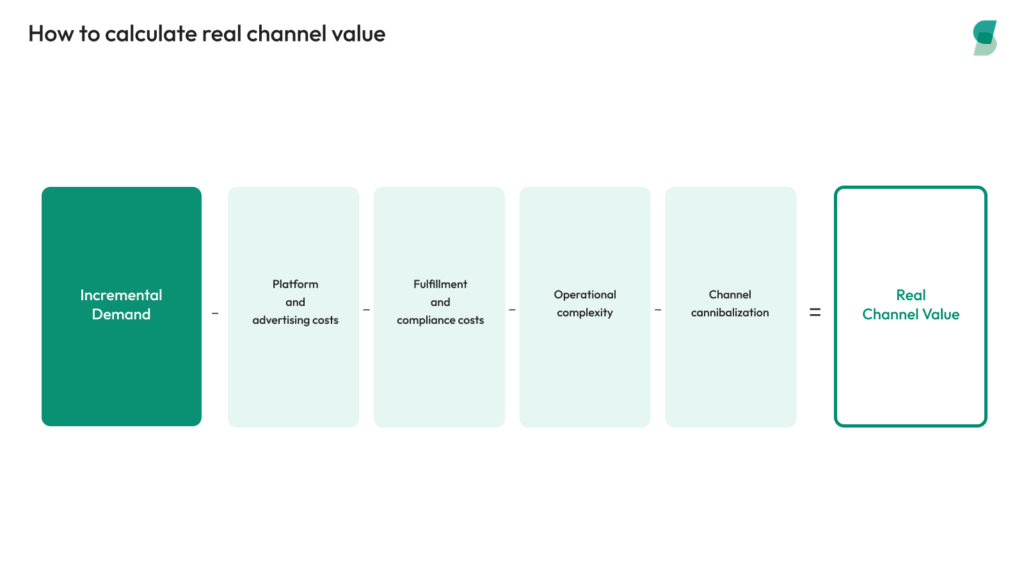
Real Channel Value
= Incremental Demand − Channel Costs − Operational Complexity − Cannibalization
Incremental demand asks whether the channel brings genuinely new customers or simply moves existing sales away from another platform.
Channel costs include commissions, retail media, promotional funding, fulfillment fees, and retailer deductions.
Operational complexity includes the additional work required to maintain inventory, product mappings, purchase orders, routing, labels, advance shipping notices, invoices, and exceptions.
Cannibalization measures how much of the apparent growth would have occurred through an existing channel anyway.
This does not mean every new channel needs to be operationally simple. Some complex retail accounts are highly valuable.
It means the complexity should be visible before the launch—not discovered after order volume begins to grow.
Operational Readiness Quietly Limits Channel Strategy
Channel expansion is usually treated as a commercial decision. In practice, retail supplier operations often determine which opportunities are actually available.
A channel may look attractive on paper, but the supplier may not yet have the ability to:
- Maintain accurate inventory across platforms
- Process retailer-specific EDI or API transactions
- Capture carton-level packing information
- Complete routing and ASN requirements on time
- Coordinate orders with a warehouse or 3PL
- Detect rejected documents or delayed orders
- Monitor scorecards, deductions, and exceptions
When these capabilities are missing, the supplier has three choices: add more manual work, delay the opportunity, or accept higher compliance and margin risk.
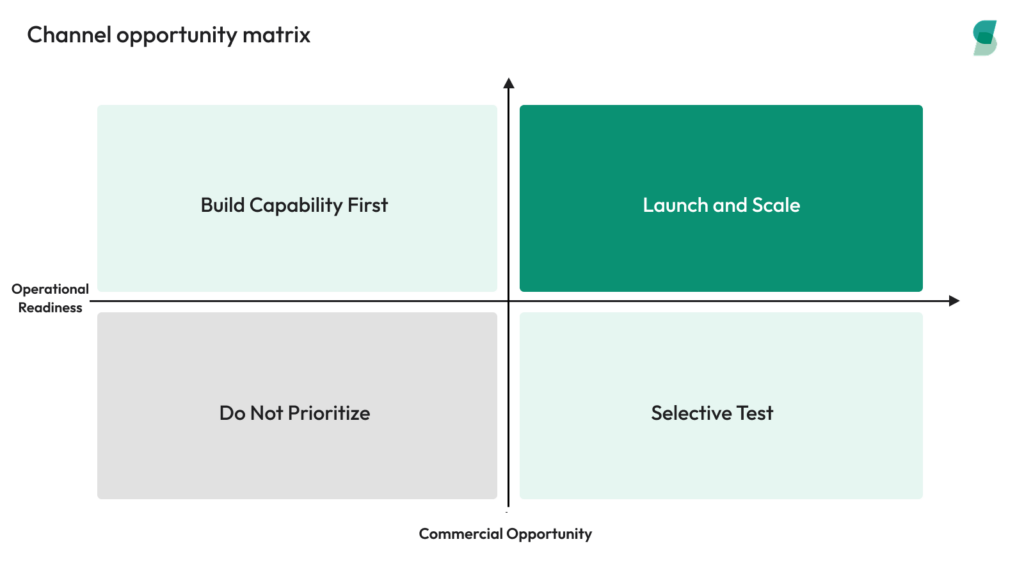
Operational readiness should therefore be evaluated alongside commercial potential.
A simple decision framework is:
| Commercial opportunity | Operational readiness | Recommended action |
| High | High | Launch and scale |
| High | Low | Build the operating capability first |
| Low | High | Run a limited test |
| Low | Low | Do not prioritize |
What Should Suppliers Review Before Adding a Retail Channel?
Before adding a second—or fourth—channel, suppliers should answer four questions:
Does the channel create incremental demand?
Identify whether it reaches a new customer, category, geography, or retail relationship.
Are the unit economics attractive after all costs?
Include advertising, fulfillment, deductions, promotional funding, and operational labor—not only marketplace fees.
Can the current operation support the retailer’s requirements?
Map the process from order receipt through inventory, fulfillment, shipment confirmation, invoicing, and reconciliation.
Can exceptions be identified before they become penalties?
The most expensive orders are often not the largest ones. They are the orders that miss acknowledgment deadlines, fail routing requirements, produce rejected ASNs, or generate inaccurate invoices.
Better Channel Decisions Require Better Operational Visibility
The 2026 ecommerce concentration data is not telling suppliers to sell everywhere.
It is telling them that the majority of demand is controlled by a relatively small group of retailers—and that selecting the right combination is becoming a strategic capability.
Amazon will remain the anchor channel for many businesses. But the next best opportunity may be Walmart, a category retailer, a wholesale account, or a dropship program.
The right answer depends on more than potential GMV. It depends on incremental demand, real margins, operational complexity, and the supplier’s ability to execute consistently.
Synctify helps suppliers coordinate retailer-specific orders and workflows across Amazon, Walmart, Wayfair, Home Depot, Lowe’s, Sam’s Club, and other major US retail channels.
👉 Talk with Synctify about evaluating the operational readiness of your next retail channel.
Subscribe to Our Newsletter
Get the latest releases, news and more!