
AI has made software feel more accessible than ever.
A few years ago, even a modest ecommerce automation usually required an engineer, a contractor, or another software purchase. Today, an operations manager can describe a problem to an AI assistant and end up with a working script, a transformed spreadsheet, or a basic workflow in a matter of hours.
That is genuine progress.
It is also leading more ecommerce companies to ask a reasonable question:
If AI can help us build our own automations, do we still need an OMS, ERP, integration platform, or system provider?
At Synctify, we think that is exactly the right question to ask.
Our answer is not that every company needs more software. Many tasks are better handled with AI. Others are too important to be held together by a collection of scripts, prompts, and point solutions.
The real distinction is simple:
Are you automating a task, or are you operating a system the business depends on?
Some ecommerce work should be handled with AI
AI is already a practical tool for a wide range of ecommerce work.
It can clean product data, reformat spreadsheets, summarize weekly sales, generate product content, create internal reports, or trigger a basic alert when inventory drops below a threshold.
For narrowly defined tasks, that can be the right solution.
If a report is wrong, someone can review it. If a file conversion fails, the process can be rerun. If product copy needs revision, it can be edited before publication.
The downside is limited, visible, and usually recoverable.
Businesses should use AI for work like this. At Synctify, we do not believe every operational problem needs an enterprise platform.
The issue begins when the same approach is applied to orders, inventory, fulfillment, invoicing, or retailer compliance.
At that point, the question is no longer whether AI can generate the code.
The question is whether the business is prepared to own everything that happens after the code goes live.
The hard part of ecommerce automation is rarely the first version
Connecting to an API is easier than it used to be.
Understanding the operational logic behind that connection is not.
A company may be able to use AI to pull orders from Amazon, send inventory updates to Walmart, create a warehouse export, or return shipping data to a retail channel.
Technically, those actions are increasingly accessible.
Operationally, each one sits inside a much larger process.
Amazon, Walmart, Wayfair, Home Depot, Lowe’s, and other major retail channels all have their own requirements for order acknowledgment, inventory reporting, packing data, labels, routing, shipment notices, EDI transactions, invoicing, cancellations, and returns.
Those requirements are not interchangeable.
A status that means one thing in one channel may mean something different in another. A field that is optional in one workflow may be mandatory elsewhere. A process that works for a marketplace order may not work for a first-party vendor relationship.
The rules also change.
Retailers update APIs, revise required fields, change authentication methods, and introduce new operational or compliance requirements.
An integration can work perfectly when it is first created and still need meaningful changes six months later.
That would be manageable if every failure were obvious.
Many are not.
A workflow may continue running while missing a subset of orders. Inventory updates may fail only for certain products. A shipment status may be returned incorrectly while the rest of the integration appears healthy. An invoice may be transmitted without a required reference and remain unresolved until payment is delayed.
By the time the business notices, the operational damage may already be done.
This is why the value of a professional system provider is not simply the ability to build the first connection.
It is the ability to understand the business process, maintain the integration, monitor exceptions, and adapt the workflow as the platform and the business change.
We have seen what happens when the penalty notice becomes the first alert
We have seen this risk play out in a real customer environment.
Before moving to Synctify, one high-volume multichannel supplier relied on internally developed scripts to manage parts of its order processing and data submission workflows.
Most of the time, the scripts appeared to be doing their job.
The problem was that when something failed quietly, the operations team had no reliable way to know.
In one instance, invoice data was not reported to a retail channel within the required timeframe.
The issue went undetected for nearly a month.
By the time the company learned that the workflow had broken, the notification did not come from an internal alert or monitoring dashboard. It came in the form of approximately $20,000 in retailer penalties.
The lesson was not that internally developed scripts will always fail. Any technology can fail.
The real issue was that the business had no effective mechanism for detecting the exception, identifying the affected transactions, and correcting the problem before the financial impact accumulated.
The script was still running.
The workflow simply was not completing in the way the retailer required.
For a low-risk internal task, discovering a broken automation after the fact may be inconvenient.
For invoicing, fulfillment, or retailer compliance, a penalty notice should never be the first alert that a workflow has stopped working.
Retailers measure execution, not technical effort
A retailer does not care whether an integration was built by an internal developer, an outside provider, or an AI tool.
It cares whether the supplier performed correctly.
Was the order acknowledged on time?
Was inventory accurate?
Was the shipment prepared according to the retailer’s requirements?
Was the advance shipment notice submitted?
Did the invoice match the shipment?
Was a cancellation communicated before the warehouse shipped the order?
When the answer is no, the consequence is rarely limited to a technical inconvenience.
The supplier may face chargebacks, canceled orders, late shipment penalties, warehouse rework, inventory discrepancies, poor vendor performance scores, or a damaged retailer relationship.
In more serious cases, repeated failures can put an important sales channel at risk.
This creates an uncomfortable imbalance in the build-versus-buy decision.
The savings from internal automation are easy to see. The business avoids a subscription fee or a service contract.
The risk is harder to price because it may remain invisible until something goes wrong.
One failed inventory synchronization during peak season can cost more than months of software fees. One invoice workflow that quietly stops reporting the correct data can accumulate meaningful penalties before anyone realizes there is a problem.
For low-risk work, experimentation is healthy.
For workflows tied directly to revenue and retailer performance, the cheapest first version is not always the lowest-cost solution.
A collection of automations eventually becomes a system
Most internal automation environments do not begin as complex systems.
They grow one small solution at a time.
A team creates an order export. Then it adds an inventory update. Later, it builds a warehouse file, a shipping confirmation process, an invoicing workflow, and a few exception alerts.
Each piece may work well on its own.
The complexity appears when those pieces begin to depend on one another.
An order affects inventory. Inventory affects availability. Availability affects sales. Sales affect warehouse allocation. Warehouse updates affect shipment confirmation. Shipment confirmation affects invoicing. Invoicing affects payment reconciliation.
Once those dependencies exist, the business is no longer managing a few useful scripts.
It is operating a production system.
That system needs answers to questions a standalone automation does not have to address.
What is the source of truth when two platforms disagree?
How are duplicate transactions prevented?
What happens when a process fails halfway through?
Can a failed transaction be retried without creating a second shipment or invoice?
Who is notified when a synchronization stops working?
Can the team see the full history of an order?
What happens when volume triples during peak season?
Who maintains the workflow after the person who created it leaves?
Can a new sales channel be added without rebuilding the entire process?
These are not coding questions.
They are questions of architecture, governance, visibility, and accountability.
The real test of an ecommerce system is not whether it works on the day it launches. It is whether the business can understand what happened when an order fails, recover without creating duplicates, handle increasing volume, and add new channels without rebuilding everything from scratch.
That is the difference between an automation that works and an operational platform that can be trusted.
The most dangerous failures are the ones nobody sees
A complete outage is inconvenient, but it is usually noticed quickly.
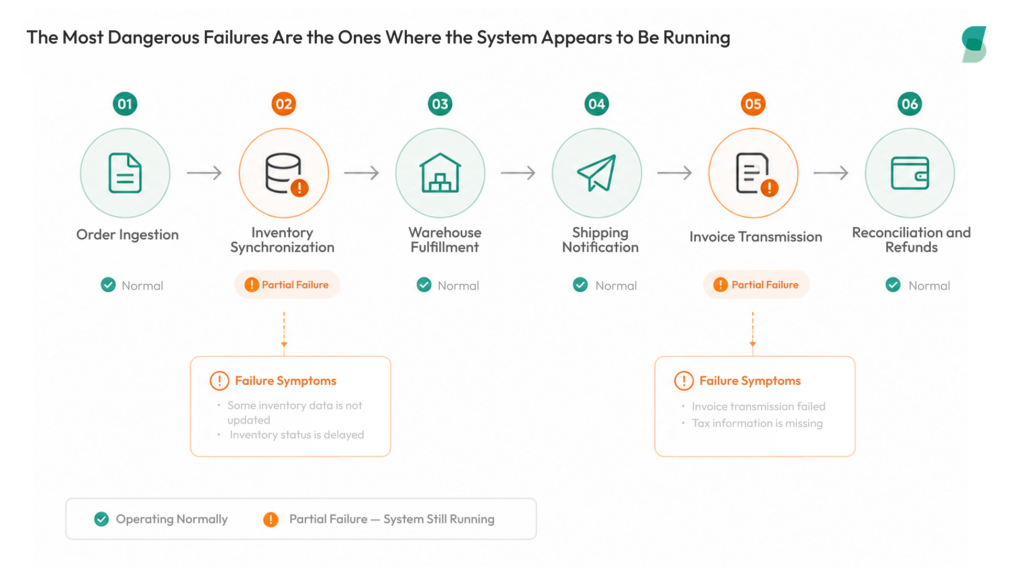
Partial failures are more dangerous.
A small number of inventory updates do not reach the retailer. One warehouse stops receiving a particular type of order. A cancellation is reflected on the sales channel but never reaches the fulfillment team. An invoice is accepted technically but cannot be matched during payment reconciliation.
At first, the error rate may be small enough to escape attention.
At scale, even a small percentage becomes a serious operational problem.
This is why mature ecommerce systems are designed around exception management, not just automation.
A reliable system should make it possible to see what failed, understand why it failed, identify which transactions were affected, and determine whether the workflow can be retried safely or requires human intervention.
The goal is not to remove people from every process.
The goal is controlled automation.
Some decisions should run automatically. Others should stop when information is missing, a SKU does not match, inventory is unavailable, or the retailer returns an unexpected response.
The business should know which is which before the exception occurs.
AI can help identify patterns, explain errors, and recommend next steps.
It does not remove the need for a system that captures and manages those errors in the first place.
AI will change software providers, but it will not eliminate the need for them
AI will reduce the value of certain types of technical work.
Basic coding, file conversion, repetitive setup, and simple point-to-point integrations are becoming faster and less expensive.
That is good for customers.
It also means software providers need to offer more than technical execution.
In the AI era, the most useful providers will be those that understand the operational context around the technology.
They will need to know how retailer workflows differ, how warehouse and ERP systems interact, where exceptions are likely to occur, and what changes as a business adds channels, locations, and order volume.
In the past, a provider might have been evaluated on whether it could build a connector.
A better question now is:
Can this provider help us design a workflow that will remain reliable as our channels, volume, team, and retailer requirements change?
That requires platform knowledge, operational experience, system design, integration maintenance, and a willingness to take responsibility when something goes wrong.
AI can accelerate the work.
It does not create operational ownership.
The future is not AI versus SaaS
The more useful model is AI on top of dependable systems.
AI can make ecommerce software easier to use. A user may ask a natural-language question about delayed orders, request a summary of inventory risk, or receive an explanation of why certain transactions failed.
But those answers are only useful if the underlying data is accurate.
The system still needs to maintain order states, synchronize inventory, manage permissions, connect channels and warehouses, prevent duplicate actions, record changes, and recover from failure.
The provider still needs to define business rules, maintain integrations, respond to platform changes, and support complex operational scenarios.
AI can become the interface through which teams understand and operate their business.
It does not replace the infrastructure that makes those actions reliable.
How should an ecommerce business decide what to build?
The simplest way to make the decision is to consider the cost of failure.
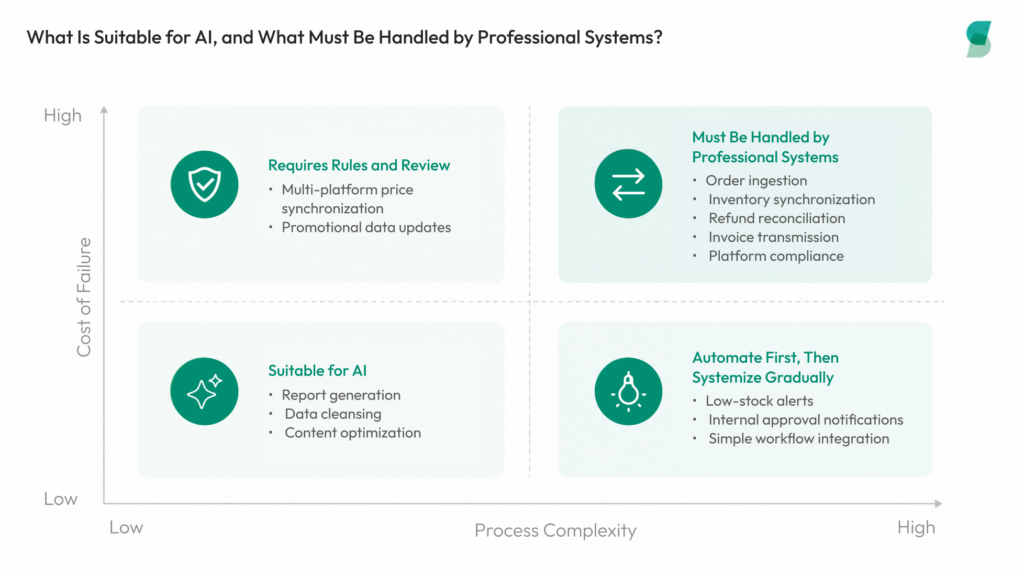
If a task is limited in scope, easy to review, and easy to reverse, AI may be all the business needs. Internal reporting, product content, data cleanup, spreadsheet transformation, and one-time analysis are good examples.
If a workflow is time-sensitive, high-volume, connected to several systems, subject to retailer compliance, or difficult to undo, it deserves a more dependable foundation.
Order ingestion, inventory synchronization, warehouse routing, shipping labels, routing requests, advance shipment notices, invoicing, and remittance reconciliation are not simply automation tasks.
They are part of the operating infrastructure of the business.
One question usually makes the distinction clear:
If this workflow fails, can the team simply run it again?
If the answer is yes, a lightweight AI solution may be appropriate.
If the failure affects inventory, fulfillment, payment, or a retailer relationship, the workflow should probably live in a system designed to manage those risks.
Synctify’s view: use AI aggressively, but not blindly
At Synctify, we do not believe ecommerce companies should choose between AI and professional software.
They should use each for what it does best.
Use AI to move faster.
Use AI to reduce repetitive work.
Use AI to make data easier to understand.
But do not assume that generated code automatically creates a reliable operating model.
Core ecommerce workflows still require stable integrations, consistent data, retailer-specific logic, process visibility, exception handling, and ongoing maintenance.
Synctify helps multichannel suppliers, sellers, and fulfillment teams manage the operational workflows between sales channels, warehouses, ERPs, and finance systems.
That includes order management, inventory synchronization, routing, shipping, invoicing, and payment reconciliation.
The objective is not to replace every internal tool or discourage businesses from building with AI.
It is to provide a dependable operational foundation so that AI can be used without turning core business processes into a collection of fragile experiments.
AI makes it easier to build something that works.
A professional system helps make sure it keeps working.
Not sure which workflows should be automated and which should be systemized?
Many businesses do not need to replace their entire technology stack.
They need a clearer view of which processes are safe to keep lightweight, which ones are creating hidden operational risk, and where disconnected systems are causing unnecessary manual work.
Synctify works with ecommerce suppliers and sellers to evaluate workflows across sales channels, warehouses, ERPs, fulfillment, and finance.
The conversation starts with how your operation works today—not with a generic software demo.
👉 Talk to Synctify about your current ecommerce workflow and get a practical assessment of what you can automate internally, what should be centralized, and where a more reliable system could reduce operational risk.
Frequently Asked Questions
blog-why-do-ecommerce-companies-still-need-software-providers
Subscribe to Our Newsletter
Get the latest releases, news and more!