

Over the past two years, major retailers have been moving faster toward third-party marketplace models.
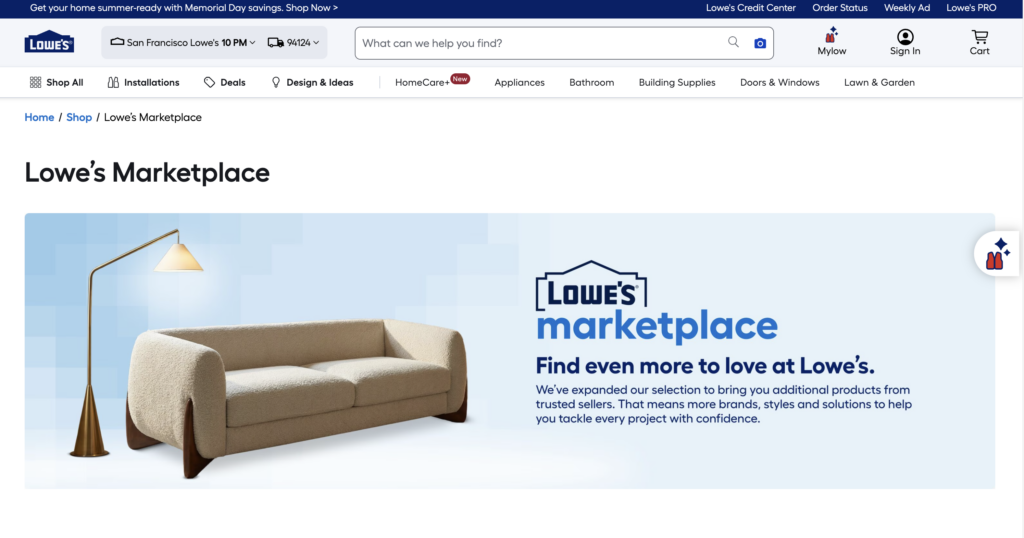
Beyond established marketplace and retail channels like Amazon, Walmart, and Wayfair, Lowe’s Marketplace is becoming a channel worth watching for suppliers in home improvement, tools, furniture, garden, building materials, and home goods.
For U.S.-based suppliers and sellers, Lowe’s Marketplace is more than just another online sales channel. It may also be an early opportunity to grow within a major home improvement retail ecosystem while competition is still less saturated than on more mature marketplaces.
Lowe’s launched its third-party marketplace model in December 2024 and announced a partnership with Mirakl in May 2025 to accelerate the growth of Lowe’s Marketplace. Through this partnership, Lowe’s aims to bring in more trusted third-party sellers, expand product selection on Lowes.com, and help sellers manage product catalogs more efficiently.
From a supplier’s perspective, this timing matters. Lowe’s Marketplace is still in an active growth stage. For suppliers in the right categories, now may be a valuable window to enter the channel, build early visibility, and establish operational performance before the marketplace becomes more crowded.
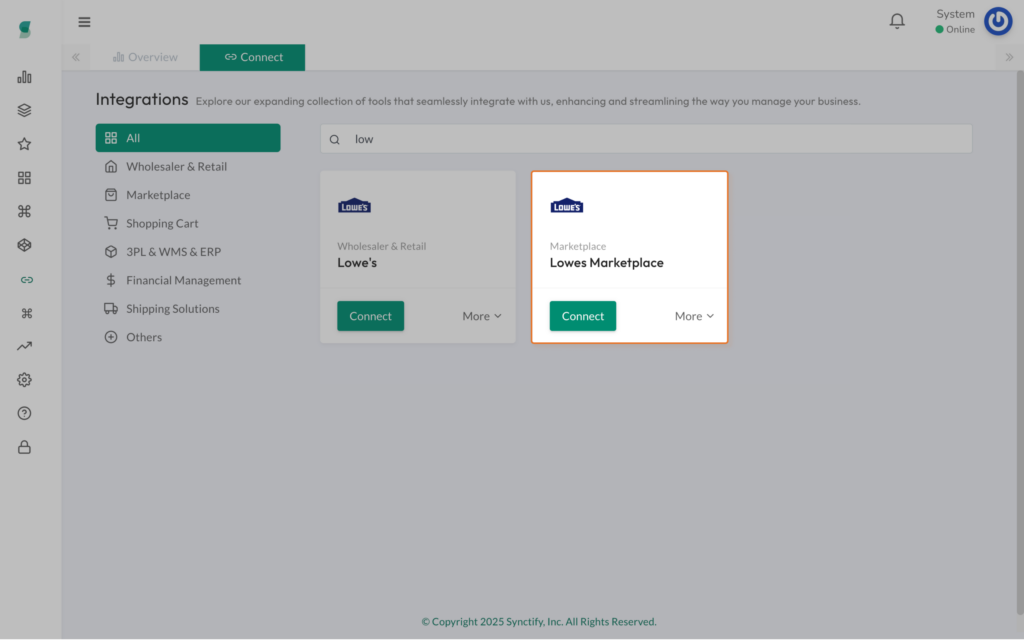
How Synctify Supports Lowe’s Marketplace Integration
For Lowe’s Marketplace, Synctify supports system integration through the Mirakl API, helping suppliers centralize marketplace orders, shipping updates, and inventory workflows inside Synctify.
For suppliers, the value of integration is not simply “connecting to another platform.” The real value is bringing Lowe’s Marketplace into an existing multi-channel operation.
Instead of logging into multiple seller portals, manually downloading orders, updating spreadsheets, entering tracking numbers one by one, or repeatedly adjusting inventory, suppliers can use Synctify to automate key data flows.
This helps reduce repetitive work, improve operational accuracy, and make Lowe’s Marketplace easier to manage alongside other sales channels.
Lowe’s Supplier Programs: Marketplace, DSV, Store Direct, and Special Order
Lowe’s supplier relationships can vary by program. In addition to Marketplace, suppliers may also work with Lowe’s through Drop-Ship Vendor (DSV), Store Direct, or Special Order programs.
This article focuses on Lowe’s Marketplace integration through Mirakl. For suppliers managing other Lowe’s programs, Synctify also supports Lowe’s DSV, Store Direct, and Special Order integrations. Learn more on our Lowe’s integration page:
进一步阅读:

Explore Our Lowe’s Integration Features
What Features Does Synctify Support for Lowe’s Marketplace?
Synctify supports the core workflows suppliers need to operate on Lowe’s Marketplace, including order management, order syncing, order acknowledgement, shipping notification sync, inventory sync, and warehouse-level inventory sync.
These features cover some of the most important day-to-day workflows for marketplace suppliers.
1. Automated Order Management
In marketplace operations, order speed and accuracy are critical.
When a customer places an order on Lowe’s Marketplace, the supplier needs to receive the order quickly and move it into the fulfillment workflow. If orders are still downloaded manually or entered by hand, the process becomes slower and more error-prone. Delays in order handling can also affect fulfillment speed.
Synctify can automatically sync Lowe’s Marketplace orders and centralize them in one system.
This is especially important for suppliers selling on multiple platforms. Instead of switching between different seller portals, teams can view and process orders from different channels in one place.
For growing suppliers, centralized order management helps create a more scalable operating model.
2. Order Acknowledgement
After an order is synced, Lowe’s Marketplace needs to know that the supplier has successfully received and accepted the order.
Synctify helps send order acknowledgement information back to Lowe’s Marketplace.
Although this step may seem simple, it plays an important role in marketplace operations. Timely order acknowledgement helps platforms evaluate whether suppliers can reliably process incoming orders. By automating this step, suppliers can reduce manual confirmation time and lower the risk of missed updates.
For teams handling higher order volumes, automated order acknowledgement can make daily operations much more consistent.
3. Shipping Notification Sync
Once an order is shipped, suppliers need to send shipping status and tracking details back to Lowe’s Marketplace.
This usually includes information such as the carrier, tracking number, and shipment status. Both the marketplace and the customer rely on this information to track delivery progress.
Synctify can automatically sync shipping notifications to Lowe’s Marketplace, helping suppliers reduce the manual work of entering tracking details.
For teams processing a large number of orders, this can significantly reduce repetitive tasks and help prevent errors caused by copying, pasting, or manually typing tracking information.
Accurate and timely shipping updates also improve the customer experience by making delivery status easier to follow.
4. Inventory Sync
Inventory accuracy is one of the most common challenges in multi-channel commerce.
When the same inventory pool supports multiple sales channels, even a small delay in inventory updates can lead to overselling, canceled orders, or fulfillment issues. These problems can affect both customer experience and supplier performance on the platform.
Synctify helps suppliers sync inventory data to Lowe’s Marketplace, so available quantities on the platform better reflect actual stock levels.
When inventory changes, Synctify can help update availability and reduce the delays and errors that often come with manual inventory maintenance.
For suppliers operating across multiple platforms, inventory sync is one of the most important capabilities for reducing overselling risk and keeping operations stable.
5. Warehouse-Level Inventory Sync
In addition to overall inventory sync, Synctify also supports warehouse-level inventory synchronization.
This means suppliers can manage inventory by warehouse location. For example, a supplier may operate multiple warehouses across different regions, work with third-party logistics providers, or manage separate fulfillment locations for different product lines. Each warehouse may have different stock levels, fulfillment capacity, and regional coverage.
With warehouse-level inventory sync, suppliers can gain clearer visibility into inventory by location and make more accurate decisions about stock allocation and fulfillment planning.
For suppliers with a large SKU catalog, multiple warehouses, or broad regional order coverage, this capability can help operations teams improve inventory visibility and reduce fulfillment complexity.
Who Should Pay Attention to Lowe’s Marketplace?
Lowe’s Marketplace is especially relevant for suppliers selling products in categories such as home goods, furniture, tools, garden, kitchen and bath, lighting, building materials, storage, and outdoor living.
It can also be a strong fit for suppliers already operating on Amazon, Walmart, Wayfair, Shopify, TikTok Shop, or other retail and e-commerce platforms, especially if they are looking to add another high-potential retail marketplace to their channel mix.
For suppliers that already have warehousing, fulfillment, and multi-channel operations in place, setting up system-based integration earlier can make future scaling much easier.
Why Lowe’s Marketplace Integration Matters
The growth of Lowe’s Marketplace reflects a broader shift in retail. More established retailers are expanding online assortment through third-party marketplace models, giving suppliers new ways to reach customers through trusted retail destinations.
But new marketplace opportunities also come with higher operational expectations.
As suppliers add more platforms, they need to manage more order sources, faster inventory changes, and more frequent shipping updates. Relying only on manual processes becomes harder to sustain over time.
By integrating Lowe’s Marketplace with Synctify, suppliers can automate key workflows such as order syncing, order acknowledgement, shipping notification sync, and inventory updates.
This allows Lowe’s Marketplace to become part of a manageable, scalable multi-channel operation instead of creating another layer of manual work.
For suppliers looking to grow across marketplace and retail channels, Lowe’s Marketplace is a channel worth watching. Synctify helps suppliers connect to this opportunity with a more stable and efficient operational foundation.
FAQ
blog-lowes-marketplace-integration
Ready to streamline your Lowe’s operations?
Let Synctify help you master Lowe’s Marketplace integration and boost your e-commerce efficiency.
Subscribe to Our Newsletter
Get the latest releases, news and more!