

Quick Answer: What Is an ASN?
An ASN, or Advance Ship Notice, is shipment information sent to a retailer, marketplace, or sales channel before or when an order ships. It tells the receiving party what items are being shipped, how many units are included, which carrier is handling the shipment, what the tracking number is, and when the shipment is expected to arrive.
For retail suppliers, ASN helps retailers prepare for receiving, update inventory, and maintain compliance. For e-commerce sellers, similar shipment notice data helps marketplaces update order status and give customers accurate tracking information.
In short, ASN helps make shipment visibility faster, more accurate, and easier to manage across sales channels.
Why Shipment Notices Matter After an Order Ships
For suppliers and e-commerce sellers, getting an order out the door is only one part of fulfillment.
Once a shipment leaves the warehouse, retailers, marketplaces, and customers still need to know what happened next. Was the full order shipped? Which items were included? What carrier is delivering it? Is there a tracking number? When should the shipment arrive?
That information is what keeps the rest of the fulfillment process moving.
If you sell to major retailers, shipment notice data helps their warehouse teams prepare for receiving and update inbound inventory. If you sell through marketplaces or online channels, shipment updates help the platform show accurate order status and tracking information to the end customer.
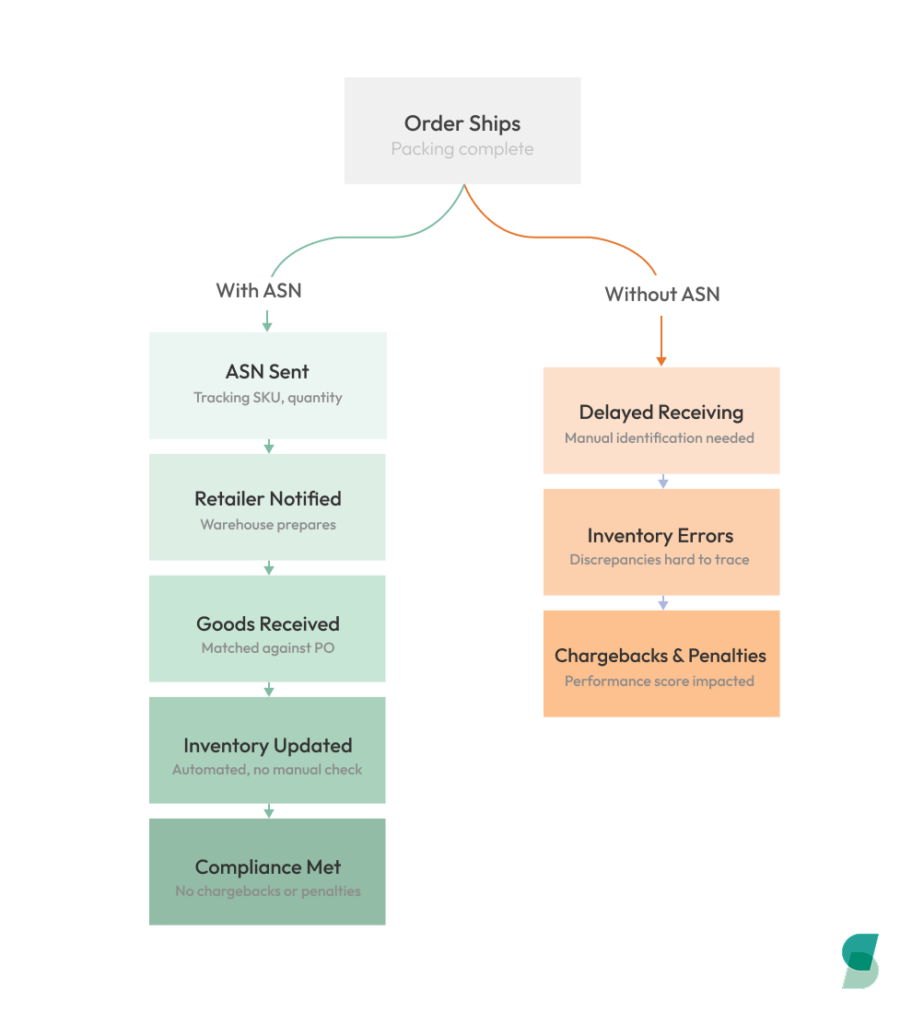
Without timely and accurate shipment notices, even a successfully shipped order can create downstream problems: delayed receiving, inaccurate inventory, customer service tickets, chargebacks, seller performance issues, and unhappy customers.
That is why ASN is not just a back-office data exchange. It is a critical part of modern retail and e-commerce operations.
What Information Is Usually Included in an ASN?
ASN requirements vary by retailer, marketplace, and fulfillment model, but most shipment notices include a similar set of core information.
A typical ASN or shipment notice may include:
- Purchase order number or marketplace order number
- Ship date
- Carrier name
- Tracking number
- SKU, UPC, item number, or barcode
- Quantity shipped
- Ship-from and ship-to information
- Carton, pallet, or package details
- Estimated delivery date
The purpose is not simply to say, “This order shipped.”
A useful shipment notice answers a more complete set of questions: what shipped, how much shipped, how it was packed, who is delivering it, and when the retailer or customer should expect it.
That level of visibility is what allows warehouses, platforms, customer service teams, and end customers to stay aligned.
Why Retail Suppliers Need ASN
If you are a supplier working with large retailers, wholesale channels, or dropship programs, ASN is often a required part of the fulfillment workflow.
Retailers need shipment details before the goods arrive. Their receiving teams need to know which purchase order the shipment belongs to, which products are included, whether the shipment is complete or partial, how many units are being delivered, and when the shipment is expected at the warehouse.
With accurate ASN data, the retailer can prepare for receiving ahead of time. When the shipment arrives, the warehouse can match it against the purchase order more quickly, complete receiving more efficiently, and update inventory with fewer manual checks.
When ASN data is missing, late, or inaccurate, the retailer may need to manually identify and reconcile the shipment. That slows down receiving and increases the risk of inventory discrepancies.
ASN also plays a major role in retail compliance. Many retailers have strict requirements for shipment notices. If a supplier sends the ASN late, leaves out tracking information, submits the wrong item number, reports incorrect quantities, or fails to meet formatting requirements, the supplier may face chargebacks, penalties, delayed payments, or lower performance scores.
For suppliers, ASN supports three major business outcomes:
- Faster warehouse receiving for retailers
- More accurate inventory and order data
- Lower risk of chargebacks and compliance issues
ASN is not just a technical document. It is part of how suppliers prove they can support large-scale retail operations reliably.
Why E-Commerce Sellers Need Shipment Notices
E-commerce sellers may not always hear the term “ASN” from every marketplace or platform. A platform may call the same type of data a shipment confirmation, fulfillment update, tracking update, or shipping notice.
The name may be different, but the purpose is the same: the seller needs to send accurate shipment information back to the sales channel.
When an e-commerce seller submits shipment information, the platform can update the order from “processing” or “awaiting shipment” to “shipped.” It can also display the carrier, tracking number, and delivery status to the customer.
That customer-facing visibility matters.
Most customers do not see what happens behind the scenes after they place an order. They simply expect to know whether the order shipped, where the package is, and when it will arrive. If shipment data is not sent on time, the customer may see an order stuck in “processing” even if the package has already left the warehouse.
That creates avoidable friction. Customers may contact support, cancel the order, file a complaint, or lose confidence in the seller. On some marketplaces, delayed or missing shipment updates can also affect seller performance metrics.
For e-commerce sellers, shipment notices help:
- Keep marketplace order status up to date
- Provide customers with accurate tracking information
- Reduce “Where is my order?” support requests
- Protect seller ratings and fulfillment performance
- Build trust with customers after purchase
In e-commerce, shipment data is not just operational data. It is part of the customer experience.
The Challenge: Multi-Channel Fulfillment Makes Shipment Updates Harder
Shipment updates are manageable when you sell through one channel and process a small number of orders.
They become much harder when your business grows.
A supplier may need to send detailed shipment notices to multiple retailers. An e-commerce seller may need to update orders across several marketplaces, storefronts, warehouses, and third-party logistics partners. Each channel may expect shipment data in a different format, with different required fields and different timing rules.
One channel may require carton-level details. Another may only need a carrier and tracking number. One platform may support API-based updates. Another may require portal entry or file upload. Some channels may penalize late updates, while others may reject incomplete shipment data.
When teams handle all of this manually, errors become more likely.
A wrong tracking number can prevent a customer from locating a package. A quantity mismatch can slow down warehouse receiving. A late shipment update can hurt marketplace performance. Missing shipment data can lead to chargebacks or compliance issues.
The more channels a business adds, the more important it becomes to manage shipment notices through a repeatable, scalable process.
Why Shipment Notice Automation Matters
ASN and shipment notice workflows are strong candidates for automation because they depend on accurate, timely, and consistent data.
To send a reliable shipment notice, teams often need information from several systems: order management, inventory, warehouse operations, shipping carriers, third-party logistics providers, and sales channels. If employees have to manually copy data between systems, the risk of errors increases quickly.
Automation helps centralize that process.
Instead of entering shipment details into multiple portals or spreadsheets, suppliers and sellers can use automation to collect shipment data, validate key fields, and send updates back to each channel based on its requirements.
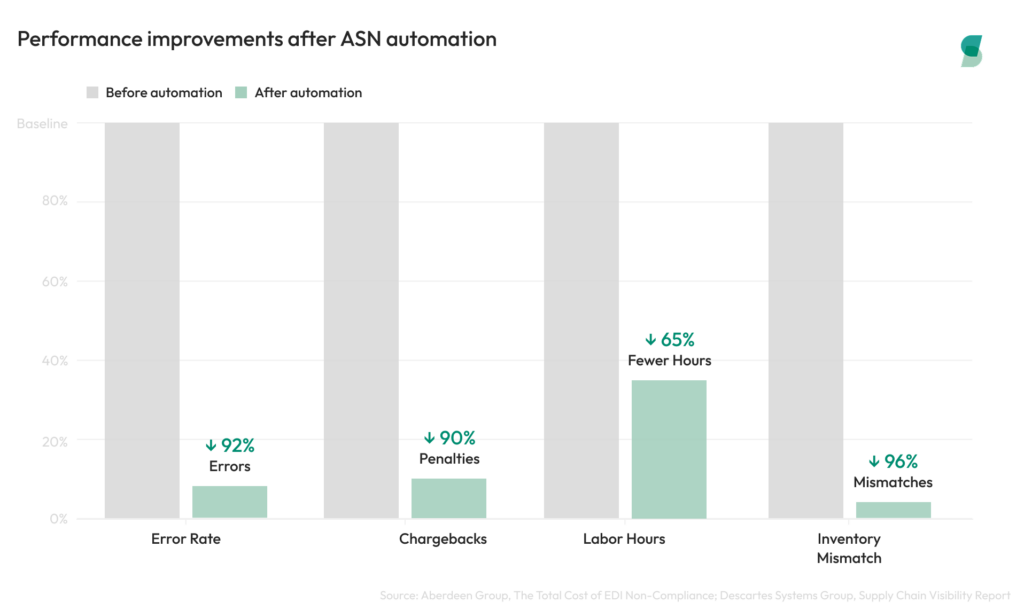
The value is not only time savings. Automation can also reduce errors in tracking numbers, item numbers, quantities, and delivery updates. It can help prevent late updates, reduce chargebacks, lower customer complaints, and give operations teams better visibility across channels.
For growing suppliers and e-commerce sellers, shipment notice automation is not just an efficiency improvement. It is part of the infrastructure needed to scale.
How Synctify Helps Suppliers and E-Commerce Sellers Manage Shipment Notices
Synctify helps suppliers and e-commerce sellers centralize order, inventory, shipment, and tracking workflows across multiple retail and e-commerce channels.
For ASN and shipment notice workflows, Synctify helps teams bring orders from different channels into one centralized process and automatically sync shipment and tracking information back to the required channels.
Whether a channel requires a specific shipment notice format, an API shipment update, a portal workflow, or another fulfillment update method, the business goal is the same: send accurate shipment information back to the channel on time.
With Synctify, suppliers and sellers can reduce manual work, improve shipment data accuracy, and make multi-channel fulfillment easier to manage.
Synctify helps teams:
- Centralize orders across multiple channels
- Sync shipment status and tracking information automatically
- Send shipment data based on each channel’s requirements
- Reduce manual entry and repetitive work
- Lower the risk of shipment errors, chargebacks, and customer complaints
For retailers, this means faster receiving and better inventory visibility. For marketplaces, it means more accurate order status updates. For end customers, it means clearer tracking information and a better post-purchase experience.
For suppliers and e-commerce sellers, the value is simple: shipment notice workflows become more systematic, automated, and scalable.
Conclusion: ASN Is About Visibility, Accuracy, and Trust
ASN may sound like a technical term, but its business impact is practical.
For retail suppliers, ASN helps retailers receive shipments faster, update inventory more accurately, and maintain compliance. For e-commerce sellers, shipment notice data helps marketplaces update order status and give customers the tracking visibility they expect.
The exact format may vary by channel, but the purpose is the same.
Sales channels need accurate shipment data. Suppliers and e-commerce sellers need a reliable way to send it on time, across every channel they manage.
As order volume grows and fulfillment requirements become more complex, manual shipment updates become harder to sustain. A centralized, automated workflow helps teams reduce errors, protect performance, and scale with confidence.
FAQ
blog-what-is-an-asn
Subscribe to Our Newsletter
Get the latest releases, news and more!