

A practical comparison of business model, operational requirements, technical complexity, and seller fit.
When businesses evaluate ecommerce growth opportunities, one of the first questions they ask is simple: Which platform should we sell on?
It is a reasonable starting point, but it is rarely the most important one.
In ecommerce, platform choice matters. But what shapes your margin structure, operating model, internal workflows, technical requirements, and long-term scalability is often not the platform itself. It is the channel model behind it.
That is where many brands, sellers, and suppliers misjudge the opportunity. Two companies may both be selling online, yet they may be operating under completely different commercial structures. One may be selling through a marketplace, where the seller controls pricing, product listings, and day-to-day performance. The other may be working through a retail model, where a retailer buys inventory and controls the customer-facing selling environment.
From the outside, both look like ecommerce. In practice, they demand very different capabilities.
That is why businesses should not start by asking only where they want to sell. They should first ask how they want to sell.
Why channel model matters more than platform choice
A platform determines where your products appear. A channel model determines how the business actually works.
That distinction affects almost every part of ecommerce execution, including who owns inventory, who sets prices, how products are discovered, who manages fulfillment, what systems need to be integrated, and how revenue and costs are structured.
If a business focuses only on the platform, it can easily choose a channel that does not fit its strengths. A brand that needs speed and flexibility may end up in a model built around long onboarding cycles and wholesale processes. A supplier with strong operational discipline may underestimate how much marketplace success depends on content, advertising, and conversion optimization. A seller may think they are choosing a source of traffic, when they are actually choosing a completely different commercial relationship.
That is why channel strategy should come before platform strategy. Choosing the right ecommerce channel model is not just a distribution decision. It is a business model decision.
Marketplace vs. retail: what is the difference?
At the highest level, the difference comes down to one question: Who are you selling to?
What is a marketplace?
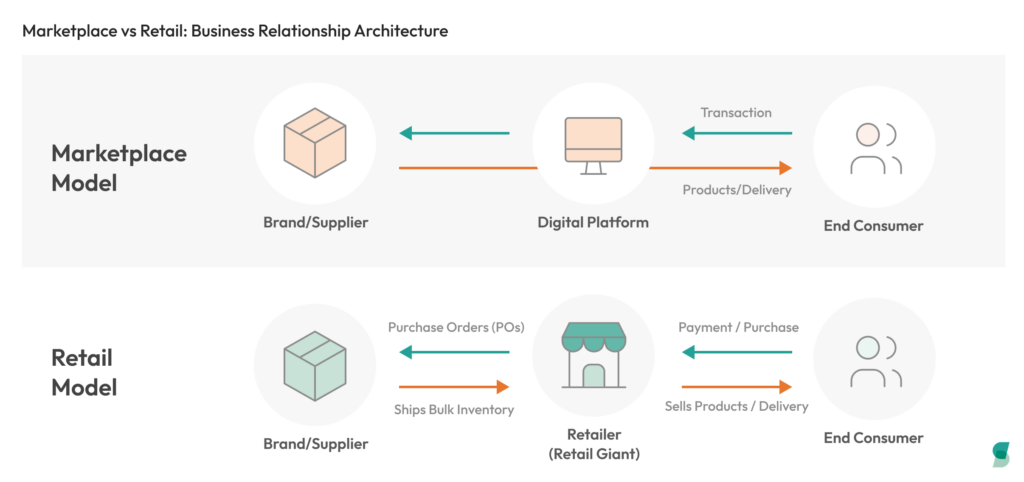
A marketplace is a selling environment where third-party sellers offer products directly to consumers through a platform.
In this model, the seller is typically responsible for product listings, pricing, promotions, inventory, and performance. The platform provides traffic, transaction infrastructure, and, in some cases, fulfillment, advertising, and operational tools.
Put simply, in a marketplace model, you sell to the customer through a platform.
What is a retail model?
In a retail model, a retailer purchases products from a brand or supplier and then resells those products to the end customer.
Here, the retailer usually controls the customer-facing experience, including pricing, promotions, merchandising, and assortment placement. The supplier’s primary commercial relationship is with the retailer, not with the shopper.
Put simply, in a retail model, you sell to the retailer, and the retailer sells to the customer.
The simplest way to compare the two
If you want the shortest possible distinction:
- Marketplace = you sell on a platform
- Retail = you sell into a retailer
That one difference creates major downstream implications for pricing control, operational complexity, technical requirements, and overall channel strategy.
Why businesses often confuse marketplace and retail
One reason companies make poor channel decisions is that they evaluate opportunities by platform name rather than by operating model.
The same ecommerce company may support more than one route to market. What looks like one channel from the outside may actually include very different commercial structures depending on the supplier relationship.
That is why platform name alone does not tell you enough. Two brands may both say they are selling on the same ecommerce destination, while one is operating as a third-party seller and the other is supplying inventory under a retail relationship. Those are fundamentally different businesses, even if the shopper sees them in a similar environment.
Before deciding where to expand, businesses need to understand the structure of the channel itself.
Marketplace vs. retail: key differences in business model and operations
The most important differences between marketplace and retail usually show up across six areas: commercial relationship, pricing control, discoverability, fulfillment, economics, and brand control.
1. Commercial relationship: who are you actually selling to?
In a marketplace model, the seller generally sells directly to the end customer, even though the transaction takes place on a platform.
In a retail model, the supplier sells to the retailer, and the retailer sells to the end customer.
This affects more than contract structure. It changes the entire focus of the business. Marketplace is closer to direct ecommerce execution. Retail is closer to wholesale supply and channel management.
2. Pricing and promotion control
One of the biggest advantages of marketplace selling is flexibility. Sellers often have more control over pricing, promotional cadence, and assortment changes.
In a retail model, final selling price is usually controlled by the retailer. Brands may influence pricing strategy, but they often do not fully control it. The retailer decides how products are merchandised, discounted, bundled, or positioned within broader category plans.
For businesses that care deeply about price integrity, promotional timing, and brand positioning, this is a major difference.
3. Product discovery and traffic drivers
In a marketplace, visibility is usually driven by search ranking, advertising, reviews, conversion performance, and platform algorithms. Success depends heavily on content quality and marketplace operations.
In a retail model, visibility is often shaped by assortment decisions, merchandising placement, retailer promotions, and buyer relationships. Exposure is not driven only by optimization. It is also driven by channel access and commercial alignment.
A useful shorthand is this:
- Marketplace is performance-driven
- Retail is placement-driven
4. Inventory, fulfillment, and operational responsibility
Marketplace sellers may fulfill orders themselves or use platform-supported fulfillment services. Either way, inventory planning, stock availability, service levels, and returns management remain core responsibilities.
In a retail model, the supplier’s responsibility is usually tied to delivering inventory to the retailer according to agreed timelines, specifications, and replenishment expectations. The pressure shifts toward supply consistency, compliance, and execution accuracy.
Marketplace tends to put more pressure on order-level performance. Retail tends to put more pressure on account-level supply chain discipline.
5. Revenue structure, costs, and margin pressure
Marketplace revenue may look attractive because the seller owns the transaction, but the cost structure is often more complex than it first appears. Fees can include platform commissions, advertising spend, fulfillment charges, storage fees, returns, and promotional costs.
Retail economics work differently. The model is often shaped by wholesale pricing, trade terms, payment cycles, rebates, operational deductions, and compliance-related costs.
It is not especially useful to ask which model is more profitable in the abstract. A better question is how each model creates margin and where each one erodes it.
6. Brand control and distance from the customer
Marketplace generally allows brands to stay closer to the customer. Even if customer data access is limited by the platform, brands still have more influence over product content, reviews, pricing, and conversion levers.
Retail usually creates more distance between the brand and the shopper. The retailer controls much of the storefront, promotional environment, and customer experience.
For brands that value speed of feedback, tighter control, and more direct optimization, that difference matters a great deal.

Which sellers are a better fit for a marketplace model?
Marketplace is often a stronger fit for businesses that value speed, flexibility, and direct control over ecommerce execution.
Brands testing product-market fit
For newer brands or companies entering a new market, marketplace channels are often a practical starting point. They make it easier to test demand, evaluate price points, gather customer feedback, and validate product positioning.
Compared with retail onboarding, the path to launch is usually faster.
Sellers with broad assortments or fast-moving catalogs
Businesses with many SKUs or frequently changing assortments often benefit from marketplace flexibility. New products can be launched faster, underperforming items can be removed quickly, and pricing can be adjusted in near real time.
That makes marketplace especially valuable for brands that want to iterate aggressively.
Teams with strong ecommerce operating capabilities
Marketplace success is highly execution-driven. Listing quality, search visibility, advertising, reviews, conversion optimization, and promotional timing all play a major role.
Businesses with mature ecommerce teams often perform better in this environment because they can actively manage the levers that drive demand and conversion.
Brands that want greater commercial control
Some brands care deeply about pricing, merchandising, content, and promotional strategy.
Marketplace channels usually offer more flexibility in these areas than retail relationships do.
For businesses that want to control the pace and structure of execution, marketplace is often the better fit.
Which sellers are a better fit for a retail model?
Retail is not the right entry point for every business, but it can be a strong channel for companies with operational maturity and supply chain discipline.
Suppliers with stable production and replenishment capabilities
Retail relationships depend on consistency. Businesses that can support purchase orders, replenishment cycles, compliance requirements, and ongoing delivery expectations are more likely to succeed in this model.
Companies looking for broader distribution through established retailers
Retail can offer access to scale, shopper trust, and wider distribution through existing merchant ecosystems. For many suppliers, the value of retail is not speed. It is reach and long-term channel stability.
Organizations stronger in backend execution than frontend optimization
Retail success is often less about digital shelf tactics and more about process management. Purchase orders, invoicing, replenishment, labeling, logistics standards, and operational compliance all matter.
Companies with strong supply chain and account management capabilities may find retail better aligned with how they already operate.
Businesses that prioritize long-term account relationships
Retail may take longer to establish, but once the relationship is in place, order patterns can become more structured and predictable.
For businesses that prefer ongoing channel partnerships over constant front-end optimization, that stability can be valuable.
| Evaluation Criteria | Better Fit for Marketplace | Better Fit for Retail |
| Business Stage & Goals | Brands testing product-market fit. Ideal for quickly testing demand, price points, and validating product positioning. | Companies seeking broader distribution. Ideal for gaining reach, scale, and shopper trust through established merchants. |
| Catalog & Production | Sellers with broad, fast-moving catalogs. Allows aggressive iteration, quick launches, and real-time adjustments. | Suppliers with stable production and replenishment. Built for consistent purchase orders and ongoing delivery expectations. |
| Team Capabilities | Teams with strong ecommerce operations. Success depends on front-end execution like search, ads, reviews, and conversion. | Organizations strong in backend execution. Success depends on process management, purchase orders, invoicing, and logistics standards. |
| Control & Relationships | Brands wanting greater commercial control. Offers direct control over pricing, merchandising, content, and promotional pacing. | Businesses prioritizing long-term accounts. Offers structured, predictable order patterns and long-term channel stability. |
Technical complexity: marketplace vs. retail
A common mistake in ecommerce expansion is assuming that technical readiness looks the same across all channels. It does not.
Marketplace requires commerce operations infrastructure
Marketplace selling usually depends on systems that support product data management, listing updates, inventory synchronization, order handling, fulfillment status, returns workflows, advertising tools, and analytics.
The technical focus is on responsiveness, operational visibility, and speed.
Retail requires supply chain integration readiness
Retail typically requires stronger integration capabilities across systems and workflows. That may include EDI or API connections, purchase order handling, advance shipping notifications, invoice exchange, inventory visibility, lead-time coordination, and reconciliation workflows.
The technical focus here is less about publishing listings and more about connecting business processes across companies.
The simplest way to think about the difference
- Marketplace is more front-end operations intensive
- Retail is more back-end integration intensive
That is why some brands thrive in marketplace environments but struggle with retail execution, while some suppliers are highly capable retail partners without being especially strong in performance marketing or digital merchandising.
Entry barriers: easier does not always mean better
Marketplace is often viewed as easier to enter, while retail is seen as harder. That is only partially true.
Marketplace may have lower visible barriers at the start. Account setup and launch paths are often more straightforward. But maintaining performance is a different challenge. Competition, advertising costs, policy changes, review dynamics, and ranking pressure can make long-term profitability difficult.
Retail tends to have more obvious upfront barriers. Vendor approval, buyer acceptance, trade terms, packaging requirements, logistics standards, and systems readiness all take time. But once the relationship is established, the business may become more structured and predictable.
A more accurate comparison is this:
- Marketplace can be easier to enter but harder to sustain efficiently
- Retail can be harder to enter but easier to operationalize over time if the fit is right
That is why businesses should evaluate not just the speed of entry, but the quality of long-term fit.
How to choose the right ecommerce channel model
The right choice depends less on abstract channel definitions and more on business stage, internal strengths, and growth priorities.
Choose marketplace if:
Marketplace is often the better fit if your business needs to validate demand quickly, control pricing and merchandising more directly, move fast with assortment and promotions, or rely on a team that is strong in ecommerce operations.
Choose retail if:
Retail is often the better fit if your business has a stable and scalable supply chain, can support structured account requirements, wants broader distribution through established merchants, or is stronger in backend execution than in front-end channel optimization.
Consider both if:
In many cases, the best strategy is not choosing one model forever. It is using each model for a different purpose.
A business may use marketplace channels to test products, move quickly, and learn what converts. At the same time, it may build retail relationships for broader distribution, larger order volume, and longer-term account stability.
For many brands and suppliers, that blended approach is more realistic than treating marketplace and retail as mutually exclusive paths.
Conclusion: ecommerce strategy should start with channel model, not just platform choice
Businesses often frame ecommerce expansion as a platform decision. But that view is too narrow.
The more important question is what kind of channel model best matches the business.
Are you trying to stay close to the customer, move quickly, and control the commercial levers directly? Or are you better positioned to grow through structured retail relationships, supply chain reliability, and broader channel reach?
Those are very different paths. They create different operating requirements, different technical demands, and different margin dynamics.
That is why businesses should not just ask where they want to sell. They should first decide how they want to operate.
In ecommerce, platform choice shapes visibility.
Channel model shapes the business.
FAQ: Marketplace vs. retail
blog-marketplace-vs-retail
Subscribe to Our Newsletter
Get the latest releases, news and more!