
For sellers entering the US market, the real question is usually not whether to sell on a marketplace. It is which marketplace to prioritize first.
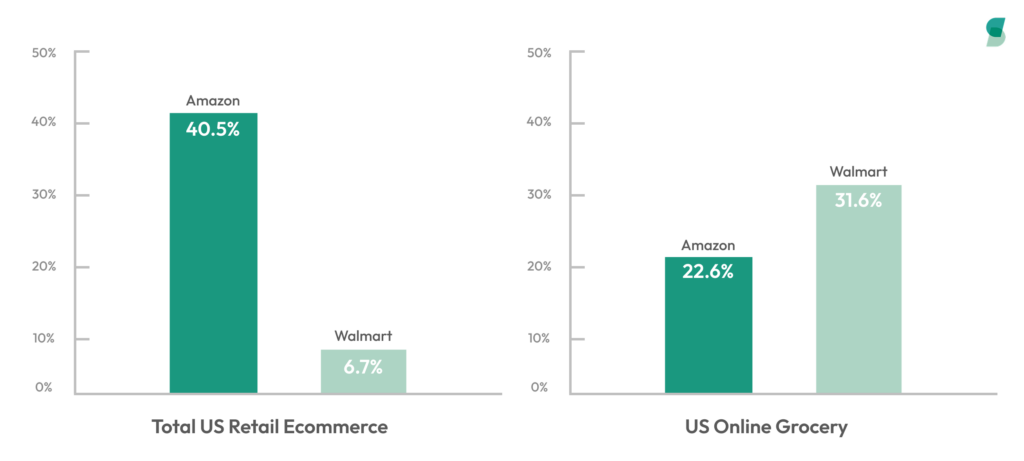
Amazon remains the dominant force in US ecommerce. EMARKETER says Amazon is expected to account for 40.5% of US retail ecommerce sales in 2025. Walmart is much smaller overall in ecommerce share at about 6.7%, but it is especially relevant in value-driven retail and grocery-linked shopping behavior. EMARKETER also projects Walmart to capture 31.6% of US grocery ecommerce sales in 2025, ahead of Amazon in that specific segment.
That gap matters because sellers are not choosing between two identical platforms. They are choosing between two different channel models. Amazon is larger, more mature, and more competitive. Walmart Marketplace is smaller, more selective, and often a better fit for household, value-oriented, and routine-purchase demand. Walmart’s own marketplace and developer materials also emphasize seller tools, API-based workflows, fulfillment options, and operational infrastructure for catalog, inventory, orders, pricing, promotions, and reports.
This guide compares Amazon Seller and Walmart Marketplace from a seller’s perspective, focusing on market share, category fit, entry requirements, fee logic, integration complexity, operational differences, and how sellers should choose between them.
Amazon Seller vs. Walmart Marketplace: The Core Difference
Amazon is still the default starting point for many brands and cross-border sellers because it combines scale, buyer intent, and a mature operating ecosystem. Amazon’s official seller pricing page shows that sellers can choose between selling plans, pay category-based referral fees, and use optional services depending on how they run the business.
Walmart Marketplace works differently. Walmart’s pricing and seller resources say that marketplace signup has no setup or monthly fee, and sellers mainly pay a referral fee when an item sells. At the same time, Walmart’s seller onboarding is more qualification-based, which means it tends to screen sellers more carefully before approval.
For sellers, this creates a practical distinction. Amazon is often the better platform for faster market entry and early demand validation. Walmart Marketplace is often more attractive as a second-stage expansion channel once a seller already has stronger compliance, fulfillment, and catalog operations in place. That conclusion is an editorial judgment based on the public differences in scale, pricing structure, and marketplace onboarding between the two platforms.
Market Share Comparison: How Big Is Amazon vs. Walmart Marketplace?
Amazon’s biggest advantage is scale. With a forecast 40.5% share of US retail ecommerce sales in 2025, it remains the single most important ecommerce platform in the US by a very wide margin. That helps explain why so many brands treat Amazon as the first marketplace to launch on. In many categories, consumer product discovery and comparison still begin on Amazon.
Walmart is much smaller in total ecommerce share, at an estimated 6.7%, but that topline figure does not tell the full story. Walmart performs especially well in everyday retail behavior, grocery-linked shopping, and household purchasing. In online grocery, Walmart is projected to hold 31.6% market share in 2025, while Amazon is projected at 22.6%. That makes Walmart strategically important for sellers whose products align with routine replenishment, household demand, or value-led shopping.
So the seller question is not simply which platform is bigger. The more useful question is where a product is more likely to convert efficiently. A marketplace with less total traffic can still be the better channel if the shopper behavior and competition structure are a closer fit for the product.
Which Product Categories Fit Amazon Better, and Which Fit Walmart Better?
Amazon generally fits products that are search-led and comparison-driven. Electronics accessories, beauty and personal care, home improvement, sports and outdoor gear, and niche functional products often do well because the Amazon shopping journey is heavily shaped by search results, reviews, listing quality, and paid visibility. Amazon’s selling model also supports this kind of optimization through structured listings, category rules, and optional service layers.
That makes Amazon especially strong when customers already know what they are looking for, or when they are willing to compare multiple similar products before buying. It also tends to favor products that are standardized and scalable, particularly when sellers are ready to compete on content, rating quality, and advertising.
Walmart Marketplace often fits a different product profile. Household essentials, daily-use products, family shopping items, value-oriented consumer goods, and grocery-adjacent products are often a more natural match for Walmart’s retail environment. Walmart’s own marketplace materials emphasize practical seller operations such as pricing, catalog management, shipping, returns, and fulfillment support, which aligns well with mainstream retail execution rather than purely search-first product discovery.
Still, category fit should not be reduced to category labels alone. Price point matters. Brand strength matters. Customer intent matters. Premium or highly differentiated products may benefit more from Amazon’s search and content ecosystem, while mainstream and price-sensitive products may align better with Walmart’s customer base. The better channel is the one that matches both the product and the operating model behind it.
Entry Requirements: Is It Easier to Start on Amazon or Walmart Marketplace?
For most sellers, Amazon is easier to start on. That does not mean it is simple. Sellers still need to navigate account setup, verification, product compliance, category restrictions, brand issues, pricing, and fulfillment choices. Amazon’s official pricing page makes clear that sellers pay according to plan type, category referral fees, and optional services.
Walmart Marketplace is more selective up front. Walmart’s public marketplace materials emphasize application-based onboarding, marketplace standards, and seller infrastructure rather than open-entry simplicity. Combined with its qualification-oriented positioning, that generally makes Walmart harder to access for sellers who are still early in their operational maturity.
In practice, this means Amazon is usually the better choice for sellers that want to validate demand quickly and enter the US market with fewer front-end restrictions. Walmart Marketplace is often better suited to businesses that already have stronger internal readiness, including documentation, fulfillment capability, and disciplined catalog operations.

Fee Structure and Profitability: Amazon Seller vs. Walmart Marketplace
Amazon’s fee model is broader and often more layered. Sellers may pay for a Professional plan, category-based referral fees, and optional costs related to fulfillment or other programs. Amazon’s public pricing page lists the Professional plan at $39.99 per month and explains that optional services can change the final cost structure.
Walmart Marketplace presents a simpler headline message. Walmart says there are zero setup, monthly, or hidden fees for Marketplace, and that referral fees vary by category and product type and are charged only when a sale is completed.
But comparing listed fees alone is not enough. The real comparison is contribution margin after ad spend, returns, shipping, fulfillment, price competition, and category-level margin pressure. A platform with a simpler public fee structure is not automatically the more profitable one. Likewise, a platform with more visible fees can still be the better option if conversion and velocity are stronger.
Technical Integration Complexity: Which Platform Is Harder to Integrate?
Amazon has the more mature ecosystem around seller operations. Even when Amazon itself is complex, the surrounding market of ERPs, OMS tools, PIM systems, feed tools, agencies, repricers, and analytics platforms is much broader. That makes it easier to find partners and workflows that support catalog uploads, order routing, ad management, and reporting. This is an inference based on Amazon’s longer-established marketplace infrastructure and the maturity of its seller environment.
Walmart’s technical capabilities are real and continue to improve. Walmart’s public marketplace materials point sellers to centralized tools, solution providers, and platform operations, while its developer documentation highlights API workflows for catalog, inventory, orders, pricing, promotions, and reports.
So the issue is not whether Walmart can be integrated. It can. The real question is how mature the surrounding ecosystem is for a seller’s specific stack and team. In many cases, the hardest part is not the API itself. It is the operational coordination required to keep product data, inventory, pricing, returns, orders, and reporting aligned across more than one marketplace.
Operational Differences: Amazon Seller vs. Walmart Marketplace
Amazon and Walmart do not just differ in scale. They also differ in how sellers win.
On Amazon, traffic is more search-led, ad-influenced, and review-sensitive. Sellers often compete heavily on keyword visibility, ratings, conversion rate, and pricing. The marketplace is mature, but that maturity comes with density. Competition is usually more intense, and category saturation can weigh on margins. This reading is consistent with Amazon’s large market share and its mature seller monetization structure.
On Walmart Marketplace, the environment can be less crowded, but seller quality and operational performance matter more during onboarding and execution. Walmart’s public marketplace positioning emphasizes seller tools, fulfillment support, and execution quality, including Walmart Fulfillment Services and centralized operational control.
That leads to one practical rule: the same SKU should not necessarily be managed the same way on both platforms. Pricing, promotions, content, fulfillment setup, and even assortment strategy often need to be adapted to the platform rather than copied over directly.
| Operational Dimension | Amazon Seller | 沃尔玛电商 |
| Traffic & Visibility Drivers | Search-led, ad-influenced, and review-sensitive. Highly dependent on keyword visibility and ratings. | Driven by seller quality, operational performance, and centralized control. |
| Competitive Environment | High density and mature. Intense competition and category saturation can weigh heavily on margins. | Less crowded environment, but requires higher standards during onboarding and execution. |
| Key to Winning | Front-end optimization (conversion rates, aggressive pricing, and ad campaigns). | Back-end operations (reliable execution, seller tools, and Walmart Fulfillment Services). |
| Single SKU Strategy | Requires continuous optimization of search rankings and promotional content. | Requires adapting fulfillment setup, assortment, and pricing; listings should not simply be copied over. |
How Should Sellers Choose Between Amazon and Walmart Marketplace?
For most sellers entering the US market for the first time, Amazon is the stronger first move. It offers larger traffic, broader consumer reach, a more established ecosystem, and a more familiar path for testing demand. That does not make it easy, but it usually makes it easier to start.
Walmart Marketplace becomes especially attractive when sellers already have operational maturity and want to expand beyond one marketplace. It can be a strong second growth channel for brands with household, daily-use, or value-oriented products, and for sellers trying to reduce overdependence on Amazon. Walmart’s positioning around centralized seller operations, pricing, fulfillment, and API integration makes it particularly relevant for businesses that are already organized enough to run another channel well.
For larger sellers with stable systems, a dual-platform strategy often makes the most sense. Amazon can remain the scale engine, while Walmart Marketplace adds diversification, incremental reach, and exposure to a somewhat different shopper profile. That is an editorial recommendation drawn from the public differences in market share, grocery strength, onboarding, and operating model between the two platforms.
Final Verdict
Amazon is usually the better first platform because it offers the largest demand pool, the strongest default buyer intent, and the most mature seller ecosystem in US ecommerce. Walmart Marketplace is usually the better second platform for sellers that already have the systems, discipline, and product fit to succeed beyond a single marketplace.
The decision should not be based on platform size alone. It should be based on whether the platform matches your category, price point, operational readiness, and growth stage. Sellers do not need the biggest channel in theory. They need the channel that works best for their products in practice.
FAQ
blog-amazon-seller-vs-walmart-marketplace
Subscribe to Our Newsletter
Get the latest releases, news and more!