

When brands start selling through Amazon Vendor Central, most of the attention goes to revenue opportunity, purchase orders, and retail expansion. But in reality, many of the biggest operational problems do not begin on the sales side. They begin in the workflow behind it.
Many brands underestimate how much Vendor operations depend on connected systems, accurate data flow, and smooth coordination across orders, inventory, fulfillment, shipment updates, and invoicing. When these workflows rely too heavily on manual work or disconnected systems, small inefficiencies can quickly turn into bigger operational issues.
That is why common Amazon Vendor Central mistakes are rarely caused by one isolated problem. More often, they come from fragmented workflows, weak integration, poor visibility across systems, and delayed responses as the business grows.
1. Treating Vendor Central Like a Simple Sales Channel
One of the most common mistakes is assuming Amazon Vendor Central works like a standard online sales platform.
In reality, Vendor Central is deeply tied to backend operations. It requires ongoing coordination across purchase orders, inventory availability, fulfillment status, shipment information, invoicing, and internal systems. Brands that focus only on sales often realize later that operational readiness matters just as much as account growth.
| Operational Dimension | Amazon Marketplace (3P) | Amazon Vendor Central (1P) | Key Challenge |
| Business Nature | Direct-to-Consumer (B2C) | Wholesale Retail (B2B) | Shift from individual sales to bulk PO management. |
| Inventory Sync | Flexible; stockouts impact ranking. | Extremely Strict; affects vendor performance score. | Real-time synchronization is mandatory to avoid OOS. |
| Logistics & ASN | Tracking numbers are sufficient. | Must comply with ASN (EDI 856) requirements. | High data integrity needed for “Last Mile” to Amazon FC. |
| Finance & Payments | Payout after platform fee deduction. | Complex Chargebacks, Allowances, & Terms. | Accuracy in Invoice-to-PO matching and dispute management. |
2. Relying Too Heavily on Manual Processes
Many Vendor workflows still depend on people to move information from one system to another, verify status updates manually, or coordinate internally before taking action.
At low volume, manual handling may seem manageable. But as order volume, SKU count, and channel complexity increase, manual work becomes harder to control. It slows down response time, increases the risk of inconsistency, and makes the workflow more difficult to scale.

3. Poor Inventory Visibility That Slows Order Confirmation
Inventory issues in Vendor operations are not only about whether stock numbers are updated. A more practical challenge is whether incoming orders can be confirmed quickly without teams manually checking stock availability first.
When inventory visibility is limited, or when inventory data is disconnected from order and fulfillment information, order confirmation becomes slower and less reliable. This creates friction at an important step in the process and makes the business more dependent on manual judgment.
4. Managing Orders, Shipments, and Invoices in Separate Silos
Another common mistake is allowing different parts of the Vendor workflow to live in separate systems without a shared view of what is happening.
Orders may be handled in one platform, shipment information in another, and invoicing in yet another system. When the flow between them is weak, teams spend more time reconciling information than acting on it. This not only reduces efficiency, but also makes it harder to identify issues early.
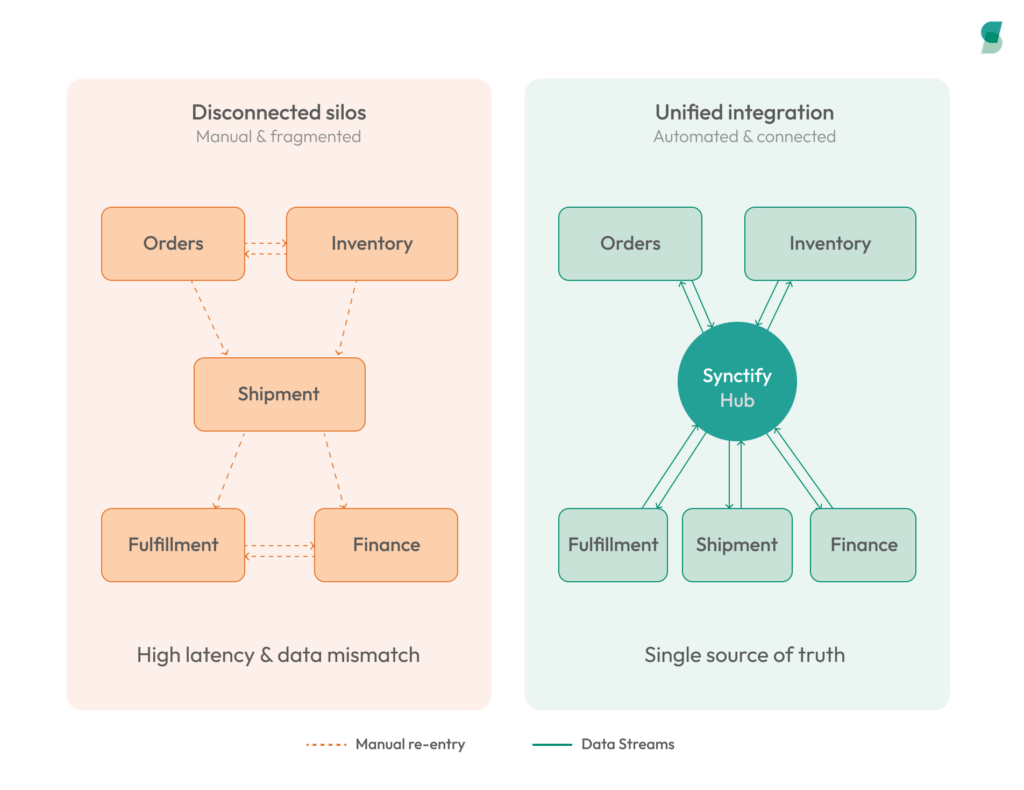
5. Underestimating Integration Requirements Across Systems
Many brands still associate Amazon Vendor integration mainly with EDI. But in practice, the challenge is broader than any single method of connection.
Depending on the workflow and system environment, EDI and API can work in parallel. The real issue is not whether a brand uses one or the other. It is whether order, inventory, shipment, and invoice data can move across systems accurately and efficiently without adding delay or manual work.
Brands that treat Vendor integration as a one-method setup often miss the larger goal: building a flexible and reliable operational workflow.
6. Lacking Visibility Across Teams and Platforms
Operational issues become much harder to solve when different teams do not have access to the same information.
Sales, operations, warehouse, finance, and IT may all be involved in the Vendor process, but if each team only sees part of the workflow, even simple decisions can take too long. Limited visibility creates communication gaps, slows down issue resolution, and makes the business more reactive than proactive.
7. Responding Too Slowly When Exceptions Happen
No Vendor workflow is completely free of exceptions. Orders change, inventory shifts, shipment timing moves, and unexpected issues happen.
The problem is not that exceptions exist. The problem is that many teams do not build a process that can detect and handle them quickly. When teams must rely on manual reviews and internal follow-ups every time something goes wrong, response speed drops and operational pressure rises.
8. Scaling Volume Before Fixing the Workflow
Many brands try to expand their Amazon Vendor business before their workflow is ready to support that growth.
What works at a smaller stage often breaks down when order volume increases. Manual review takes longer, internal communication becomes heavier, and errors become more visible. Without a stronger operational foundation, growth can expose weaknesses faster than the team can absorb them.
9. Using Fragmented Tools Across Retail Channels
For brands selling across multiple channels, another common mistake is managing Vendor Central as a standalone workflow instead of part of a broader retail operation.
When Amazon Vendor, DTC, marketplaces, and retail partners are all managed separately, data becomes fragmented and teams lose efficiency. The more disconnected the tools and processes are, the harder it becomes to maintain consistency across channels.
10. Seeing Integration as a Technical Task Instead of an Operational Strategy
A final mistake is viewing integration as something technical rather than something operational.
The value of integration is not just that systems connect. It is that teams can respond faster, reduce manual work, improve decision-making, and create a workflow that is easier to manage as the business grows. For Amazon Vendor Central, better integration is not only about system architecture. It is about building a more connected and scalable operating model.
Conclusion
Many Amazon Vendor Central mistakes do not come from a lack of effort. They come from underestimating how much the business depends on connected workflows behind the scenes.
Inventory visibility, order confirmation, shipment information, invoicing, exception handling, and cross-team coordination are all part of the same larger operational picture. Whether a brand uses EDI, API, or both, the real priority is not choosing a single integration method. It is building a workflow where information moves smoothly, manual effort is reduced, and operations can scale with greater confidence.
As more brands expand across retail channels, this kind of connected workflow becomes increasingly important. And that is also where platforms like Synctify can play a meaningful role — by helping brands bring fragmented processes together and manage Vendor operations with better visibility, stronger automation, and less manual coordination.
FAQ
blog-amazon-vendor-central-mistakes-brands-make
Subscribe to Our Newsletter
Get the latest releases, news and more!