

Visibility Has Become One of the Most Important Capabilities in Modern Fulfillment
Ask almost any ecommerce business about its operational priorities, and “visibility” will be near the top of the list.
Companies want visibility into inventory. They want visibility into orders. Increasingly, they also want visibility into shipments.
Yet one misconception appears frequently in discussions about fulfillment operations:
Many organizations assume that if they have complete order visibility, they also have complete visibility across the fulfillment process.
In reality, order visibility and shipment visibility answer two different operational questions.
Neither replaces the other, and both are essential for building an efficient fulfillment operation.
Rather than choosing between them, modern suppliers need to understand how they work together.
Order Visibility Powers Your Internal Fulfillment Operations
Every successful fulfillment operation begins with order visibility.
Before an order is ever shipped, operations teams need to coordinate inventory, warehouses, fulfillment priorities, and customer commitments.
This is where an Order Management System(OMS) plays a critical role.
Order visibility allows teams to understand where every order is within the internal fulfillment workflow, including stages such as:
- Order creation
- Inventory allocation
- Picking
- Packing
- Invoicing
- Advance Shipping Notice (ASN)
- Shipment confirmation
These operational milestones allow teams to coordinate work across sales, warehouse, customer service, and finance.
Without order visibility, efficient fulfillment simply isn’t possible.
In other words, order visibility answers one fundamental question:
Is this order ready to leave the warehouse?
Once an Order Ships, the Operational Questions Begin to Change
Shipping an order doesn’t end the fulfillment process.
It simply marks the transition into its next operational stage.
Once a package leaves the warehouse, operations teams are no longer asking:
- Has the order been picked?
- Has it been packed?
- Was the ASN successfully transmitted?
Instead, they’re asking questions like:
- Has the carrier picked up the shipment?
- Has the package received its first carrier scan?
- Is it moving through the carrier network normally?
- Has a delivery exception occurred?
- Will the shipment arrive on time?
Notice what changed.
The order hasn’t changed.
The operational focus has.
That’s where shipment visibility becomes essential.
Shipment Visibility Extends the Fulfillment Journey
Shipment visibility isn’t designed to replace order visibility.
It extends it.
While an OMS helps organizations manage the fulfillment process inside the business, shipment visibility helps them understand what happens after products leave the warehouse.
It provides operational insight into the transportation phase of fulfillment, helping teams monitor carrier activity, detect delivery exceptions, and respond proactively when shipments require attention.
The two capabilities are complementary.
One manages the order.
The other manages the journey.
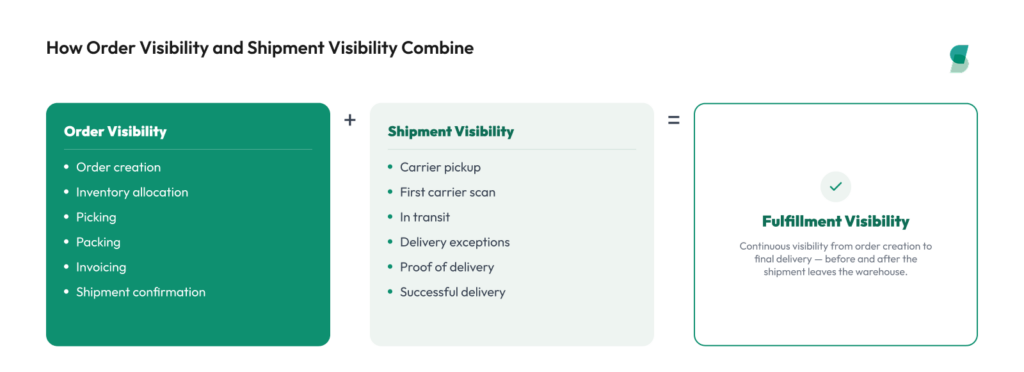
Together, they provide continuous visibility across the fulfillment lifecycle.
Modern Fulfillment Requires Both
As ecommerce operations become more complex, suppliers are realizing that visibility shouldn’t stop when an order ships.
Customers don’t think in terms of internal workflows or transportation milestones.
They simply expect their order to arrive as promised.
Meeting those expectations requires operations teams to maintain visibility across every stage of fulfillment—from order creation through final delivery.
That means combining:
Order Visibility
- Order creation
- Inventory allocation
- Picking
- Packing
- Invoicing
- Shipment confirmation
with
Shipment Visibility
- Carrier pickup
- First carrier scan
- In transit
- Delivery exceptions
- Proof of delivery
- Successful delivery
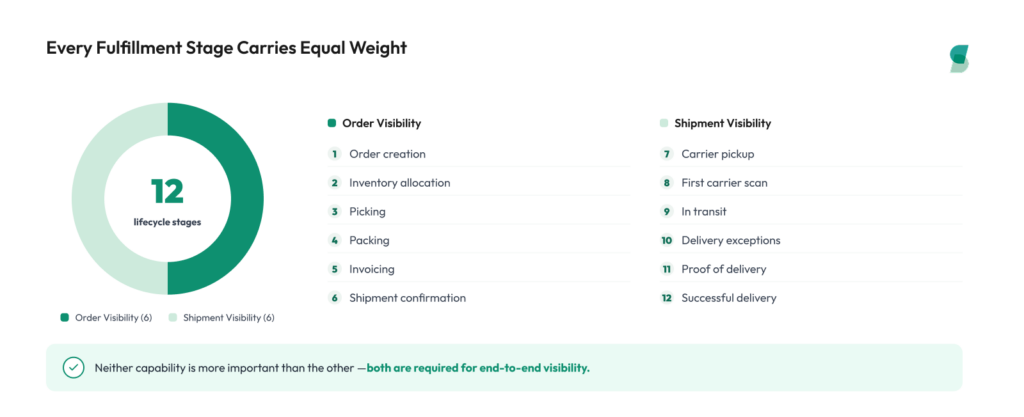
Neither capability is more important than the other.
Each supports a different stage of the same fulfillment process.
The Next Evolution: Fulfillment Visibility
Rather than thinking about order visibility and shipment visibility as separate initiatives, leading suppliers are beginning to view them as two parts of a broader operational strategy.
We call this Fulfillment Visibility.
Fulfillment visibility means maintaining operational awareness throughout the entire order lifecycle—from the moment an order is placed until it reaches the customer.
Instead of managing disconnected stages of fulfillment, operations teams gain continuous insight into what needs attention next.
This enables organizations to:
- Improve operational coordination
- Respond to issues earlier
- Reduce fulfillment delays
- Deliver a more consistent customer experience
- Continuously optimize fulfillment performance
Visibility becomes more than reporting.
It becomes an operational capability.
How Synctify Connects Order Visibility and Shipment Visibility
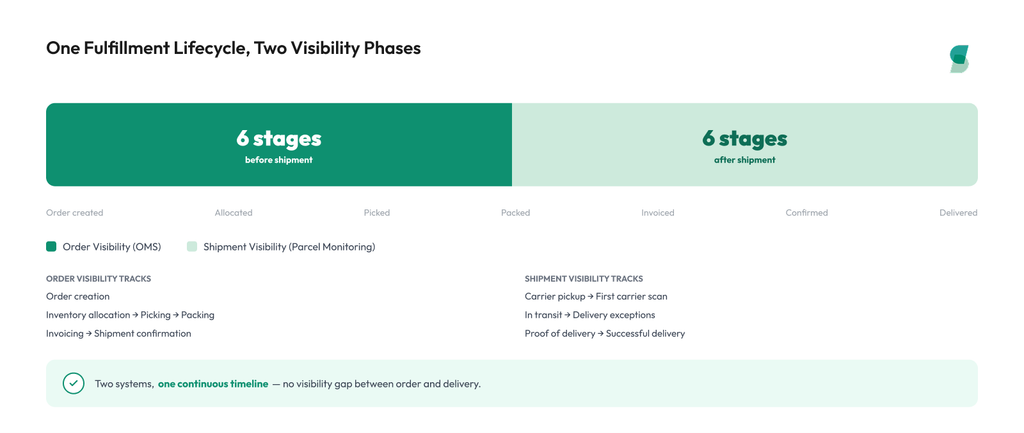
At Synctify, we believe fulfillment should be managed as one continuous operational process—not as separate systems divided by the shipping event.
That’s why our platform combines a comprehensive Order Management System(OMS) with Parcel Monitoring, allowing operations teams to maintain visibility before and after an order ships.
Our OMS helps coordinate order processing, inventory allocation, fulfillment workflows, and retailer communication.
Once an order leaves the warehouse, Parcel Monitoring extends that visibility by continuously monitoring shipment status, identifying delivery exceptions, and helping teams proactively manage transportation issues from a centralized workspace.
Together, they create a connected fulfillment experience that gives operations teams the right information at every stage of the order lifecycle.
Build Visibility Across the Entire Fulfillment Lifecycle
Order visibility and shipment visibility aren’t competing concepts.
They’re complementary capabilities that support different stages of the same fulfillment process.
Organizations that combine both gain a clearer understanding of their operations, respond to issues faster, and deliver a more reliable customer experience from order placement through final delivery.
👉 Contact our team to learn how Synctify combines Order Management and Parcel Monitoring to help suppliers build complete fulfillment visibility across every stage of the order lifecycle.
Key Takeaways
- Order visibility and shipment visibility serve different operational purposes.
- An Order Management System (OMS) provides visibility into internal fulfillment workflows before shipment.
- Shipment visibility extends operational awareness after products leave the warehouse.
- Combining both creates end-to-end fulfillment visibility across the entire order lifecycle.
- Modern fulfillment operations require both capabilities to deliver a better customer experience.
FAQ
blog-order-visibility-vs-shipment-visibility
Order visibility focuses on fulfillment activities before an order ships, while shipment visibility focuses on transportation activities after the order leaves the warehouse. Together, they provide continuous operational visibility across the fulfillment lifecycle.
No. Shipment visibility complements an OMS rather than replacing it. An OMS manages internal fulfillment workflows, while shipment visibility extends operational visibility after orders are shipped.
Fulfillment visibility is the ability to maintain continuous operational awareness throughout the entire fulfillment lifecycle—from order creation and warehouse operations to carrier transportation and final delivery.
Because fulfillment doesn’t stop when an order ships. Organizations need order visibility to coordinate internal operations and shipment visibility to manage transportation, delivery performance, and customer experience after shipment.
Subscribe to Our Newsletter
Get the latest releases, news and more!