
Shipment Visibility Isn’t About Watching Every Package
In our previous article, we explored why shipment visibility has become an operational priority for ecommerce suppliers.
The challenge isn’t that teams lack tracking numbers.
The challenge is knowing which shipments actually need attention.
As order volumes grow, checking individual tracking pages quickly becomes impractical. An operations team managing hundreds—or even thousands—of outbound shipments every day doesn’t need more tracking links.
They need a way to identify the few shipments that are most likely to become problems.
That’s why leading suppliers are shifting their focus from shipment tracking to shipment exception management.
Most Shipments Don’t Need Your Attention
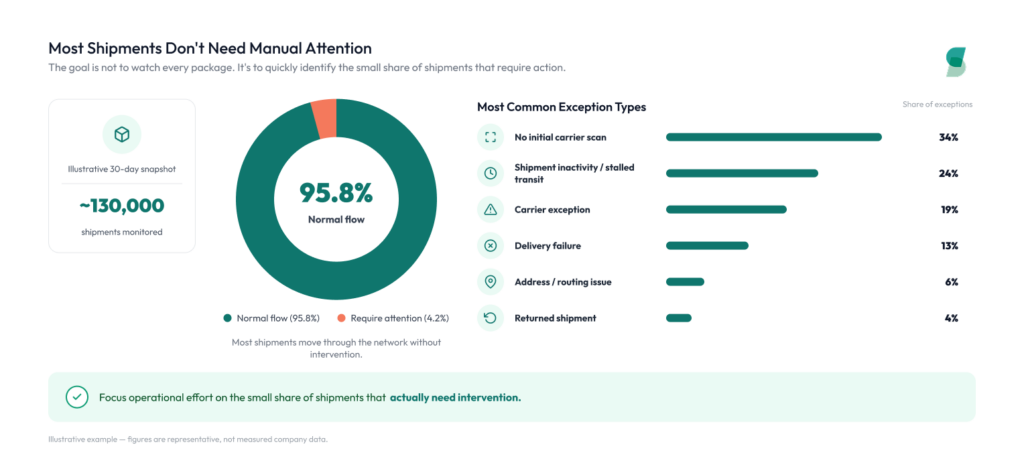
The good news is that the vast majority of shipments arrive exactly as expected.
Operations teams rarely need to intervene unless something unusual happens.
The shipments that deserve immediate attention are typically those experiencing exceptions such as:
- No initial carrier scan
- Shipment inactivity or stalled transit
- Carrier exceptions
- Delivery failures
- Returned shipments
- Address or routing issues
If every shipment is treated the same, operations teams end up spending valuable time checking orders that never needed attention in the first place.
The real operational question isn’t:
Where is this package?
It’s:
Which shipments require action today?
That simple shift in perspective changes how high-volume fulfillment teams operate.
Carrier Tracking Pages Weren’t Built for Operations Teams
Carrier websites do exactly what they’re designed to do.
They let users check the status of an individual shipment.
That’s incredibly useful when a customer asks about a single order.
It’s far less useful when your team is responsible for hundreds or thousands of shipments across multiple carriers.
Instead of checking packages one by one, operations teams need answers to questions like:
- Which shipments haven’t received a first carrier scan?
- Which deliveries have stopped moving?
- Which exceptions appeared today?
- Which issues are already being investigated?
- Which shipments are still waiting for action?
Finding a tracking number isn’t the hard part.
Identifying operational priorities is.
Shipment Visibility Requires More Than Tracking Data
Modern shipment visibility isn’t simply about collecting tracking updates.
It’s about turning transportation data into actionable workflows.
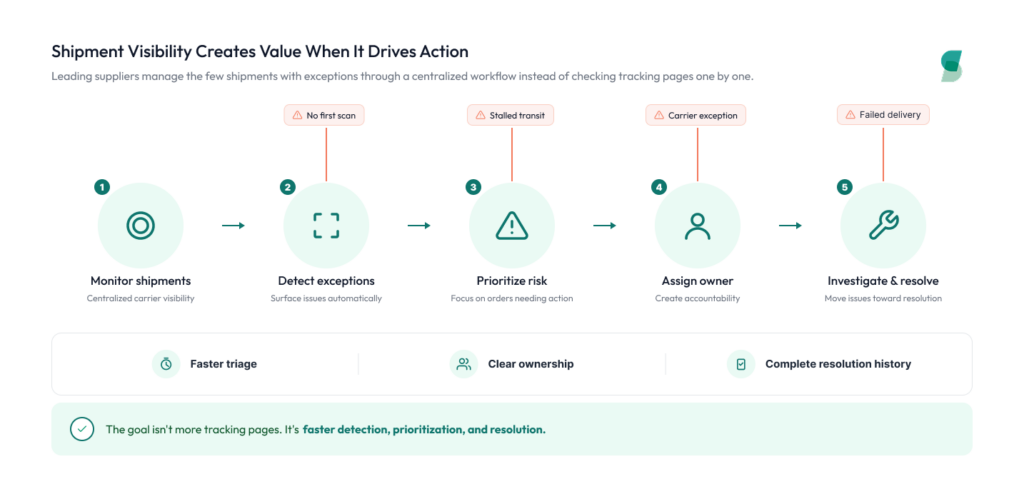
Leading suppliers increasingly rely on centralized shipment monitoring, where shipment status, carrier events, and operational tasks are brought together into a single workspace.
Instead of asking team members to manually visit multiple carrier websites, the system continuously monitors shipments and surfaces the exceptions that require attention.
That allows operations teams to spend less time searching for problems and more time resolving them.
How Synctify’s Parcel Monitoring Supports Proactive Operations
At Synctify, we built Parcel Monitoring with this operational mindset.
Rather than creating another tracking page, Parcel Monitoring helps suppliers continuously monitor shipments across carriers from a centralized workspace.
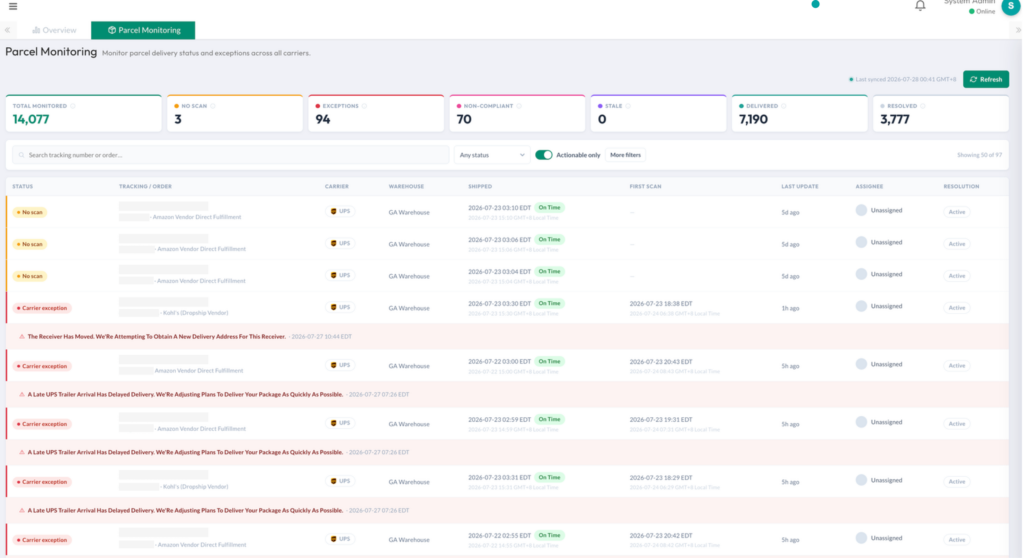
Operations teams can:
- Monitor shipments from multiple carriers in one place
- Automatically identify shipment exceptions
- Prioritize orders that require immediate attention
- Assign investigations to team members
- Add notes and track resolution progress
- Maintain a complete operational history for every exception
The objective isn’t to watch every shipment.
It’s to help teams quickly identify the small percentage of shipments that actually need intervention.
From Reactive Customer Support to Proactive Operations
Many organizations still follow a reactive workflow.
A customer asks where their order is.
Someone opens the carrier website.
The team discovers a delay.
Only then does the investigation begin.
High-performing operations teams work differently.
Shipment monitoring runs continuously in the background.
When an exception is detected—such as a missing carrier scan or stalled shipment—the operations team is notified immediately and can begin investigating before customers notice there’s a problem.
In many cases, issues are already being resolved before a support ticket is ever created.
The shipment hasn’t changed.
The operational process has.
That’s the difference between reacting to problems and preventing them from becoming customer issues.
Shipment Visibility Is Becoming an Operational Capability
As ecommerce fulfillment becomes more complex, shipment visibility is evolving into something much larger than shipment tracking.
It’s becoming an operational capability that enables teams to prioritize work, reduce delivery risks, and improve fulfillment performance at scale.
The organizations that benefit most aren’t necessarily those with the most shipment data.
They’re the ones that can identify exceptions early, coordinate responses efficiently, and continuously improve how shipments are managed after they leave the warehouse.
Continue Building Smarter Fulfillment Operations
Shipment tracking tells you where a package is.
Shipment visibility helps you understand what’s happening across your entire shipping operation.
And shipment exception management enables your team to take action before delivery issues affect customers or retailer performance.
With Synctify Parcel Monitoring, suppliers gain a centralized workspace for monitoring shipments, identifying exceptions, and managing post-shipment operations more proactively.
👉 Contact our team to learn how Synctify Parcel Monitoring can help your business improve shipment visibility and build a more proactive fulfillment operation.
Key Takeaways
- Most shipments don’t require manual monitoring—only exceptions require operational attention.
- Carrier tracking pages are useful for checking individual shipments but aren’t designed for large-scale operations.
- Shipment exception management helps teams prioritize issues instead of checking every tracking number.
- Centralized shipment monitoring improves operational efficiency and reduces reactive customer support.
- Proactive operations begin by identifying exceptions before customers notice them.
FAQ
blog-how-leading-suppliers-manage-shipment-exceptions-at-scale
Parcel Monitoring is a shipment visibility capability that continuously monitors shipments across carriers, helping operations teams identify exceptions, assign investigations, and manage delivery issues from a centralized workspace.
Common shipment exceptions include missing carrier scans, stalled shipments, delivery delays, failed delivery attempts, returned packages, damaged shipments, and carrier-reported exceptions.
Carrier tracking pages provide visibility into individual shipments, but they don’t help operations teams quickly identify which shipments require attention across hundreds or thousands of active deliveries.
By continuously monitoring shipment status and proactively responding to delivery exceptions before customers experience delays, suppliers can significantly reduce WISMO inquiries and improve customer satisfaction.
Subscribe to Our Newsletter
Get the latest releases, news and more!