

Nearly every supplier asks: “Where should we launch first?” The honest answer is fit—category behavior, logistics (parcel vs. LTL), tech readiness (API/EDI), and unit economics. In a few focused questions, we’ll quickly highlight how Amazon/Walmart, Wayfair, Target Plus, and Home Depot/Lowe’s differ—and which sellers each platform best suits.
What does “fit” really mean when choosing a channel?
Choosing channels isn’t about who’s biggest; it’s about fit across five dimensions considered together.
What are the five dimensions of fit?
- Product & buyer
- Channel model
- Operations & tech
- Economics
- Demand & brand control

When is“not a fit” a deal-breaker?
If you can’t meet SLA/EDI or compliance (e.g., Prop 65/CARB, flammability), defer the channel rather than launch and rack up chargebacks.
Where does your product naturally belong?
Start with category behavior, form factor, compliance, and returnability—this alone narrows choices fast.
How does category behavior steer you?
Furniture/Home often excels on Wayfair 和 Overstock; home-improvement lines map to The Home Depot/Lowe’s. Standardized, parcel-friendly accessories ramp quickly on 亚马逊 和 沃尔玛电商; apply to Target Plus when invited.
How do form factor & logistics change the answer?
Parcel SKUs favor 3P marketplaces(Amazon/Walmart). Bulky/fragile SKUs that rely on LTL align with retail DSV (e.g., Wayfair/Home Depot/Lowe’s/Menards/Rona Canada) where BOL, appointments, and tracking sync are standard.
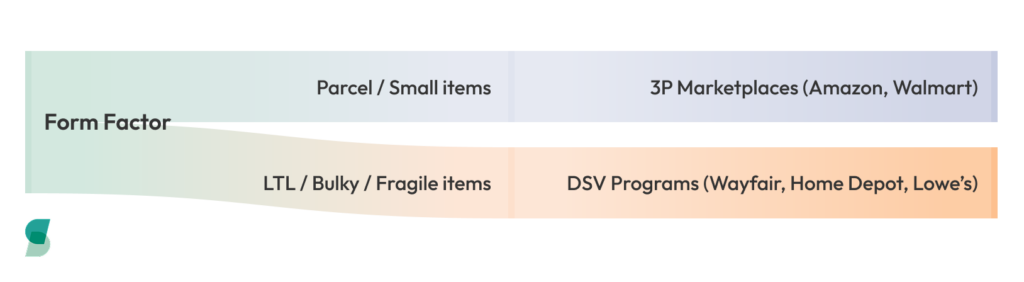
Form factor guides sales channel choice: parcel SKUs fit 3P (Amazon, Walmart), bulky/fragile SKUs fit DSV (Wayfair, Home Depot, Lowe’s).
What about compliance & returns?
Prepare Prop 65/CARB, flammability, battery/children’s documents early—especially for Macy’s/JCPenney and home-improvement channels. If refurb/resale works, 3P volume clears returns; if not, curated channels (Wayfair, Target Plus) reduce mismatch returns.
Which channel model fits your goals right now?
Pick between 3P marketplaces, retail DSV, and Direct Import/1P based on speed, control, and operational maturity.
When do 3P marketplaces make sense?
亚马逊, Walmart Marketplace, Target Plus(invite): fast testing, full content control, large traffic—balanced by SEO/PPC needs, price pressure, and owning CS/SLA.
When is retail DSV the better path?
Wayfair, The Home Depot, Lowe’s, Sam’s Club, JCPenney, Macy’s, Menards, Rona Canada: curated merchandising and category trust, but stricter routing guides and labels/ASN/invoice(810) compliance, with chargeback exposure and longer onboarding.
Who should consider DI/1P?
Factories with capacity, testing, and packaging strength—especially seasonal buys with Home Depot/Lowe’s/Sam’s Club/Wayfair buyers.
Can your operations and tech meet the rules on day one?
Match your stack to SLA priorities and data flows before you launch.
How do SLAs differ by model?
DSV stresses on-time ship, label accuracy, ASN timing; 3P stresses ship speed, valid tracking, and CX.
What tech plumbing is required?
3P leans on platform APIs; DSV/EDI requires 850/855/856/810/997 and often per-warehouse inventory(846), plus clear cancel/exception flows.
With Synctify, compliance checks and BOL generation are built into the workflow:
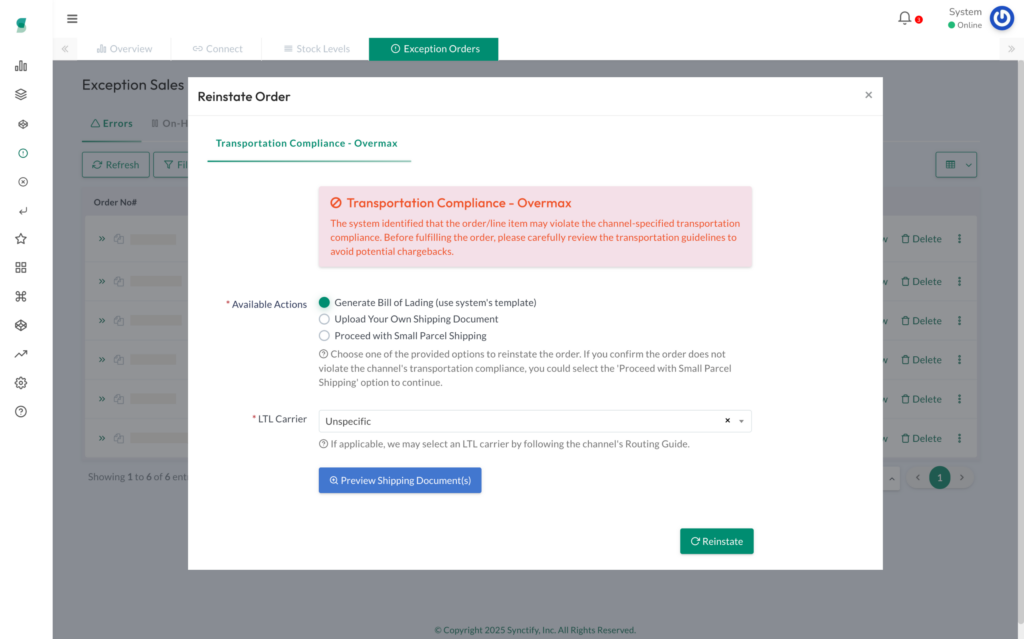
Synctify ERP automatically checks transportation compliance, flags risks before shipping, and guides users to generate the correct Bill of Lading (BOL).
What logistics discipline is non-negotiable?
LTL needs BOL generation, delivery appointments, tracking sync; parcel flows need label integration and low defect rates. Define CS ownership and return routing up front.
Will the economics actually work?
Run the math before listings go live.
How should you compare fees and terms?
Contrast take rates/fees(3P) with negotiated terms(DSV/department stores) and cash-flow timing (instant/weekly vs. Net 30/60).
How do promos and chargebacks trade off?
Marketplaces require ad spend/promo; DSV carries chargeback risk for ASN/label/shipping errors. Add return freight and refurb yield to your model.
How much demand and brand control do you need?
Balance traffic potential with content governance and gating.
Where do traffic and merchandising come from?
Amazon/Walmart = scale engines; Wayfair/Home Depot/Lowe’s = strong category discovery and curated pages.
How much can you control your brand?
3P gives content control; DSV follows retailer templates. Target Plus and some department stores are invite/gated by brand and category.
What proven playbooks map to your scenario?
Use patterns that match your catalog and ops maturity.
If you’re Furniture/Home with many LTL items…
Start Wayfair; add 亚马逊/沃尔玛 for parcel SKUs; layer Home Depot/Lowe’s once LTL ops stabilize.
If you sell standardized, parcel-friendly goods…
Start 亚马逊, layer 沃尔玛, apply to Target Plus when invited; consider Overstock for additional reach.
If you’re DI-capable with testing/QA…
Lead DI/1P with Home Depot/Lowe’s/Wayfair buyers; maintain focused 3P (Amazon/Overstock) for long tail and brand.
How should you sequence channels and control risk?
Keep momentum without overwhelming ops.
What cadence keeps SLAs healthy?
Add no more than 1–2 channels per quarter until SLAs stabilize; avoid same-SKU/same-price duplication without rock-solid inventory allocation.
What pre-PO checks prevent surprises?
Lock compliance 和 ASN/label workflows; recheck unit economics at 30/60/90 days and adjust assortment, promos, or service levels.
How does Synctify remove friction so you can choose by logic?
Synctify centralizes orders, warehouse-level inventory, ASN, invoices, and supports BOL generation 和 tracking sync across Amazon/Walmart/Overstock 和 retail DSV (Wayfair, The Home Depot, Lowe’s, Sam’s Club, etc.).
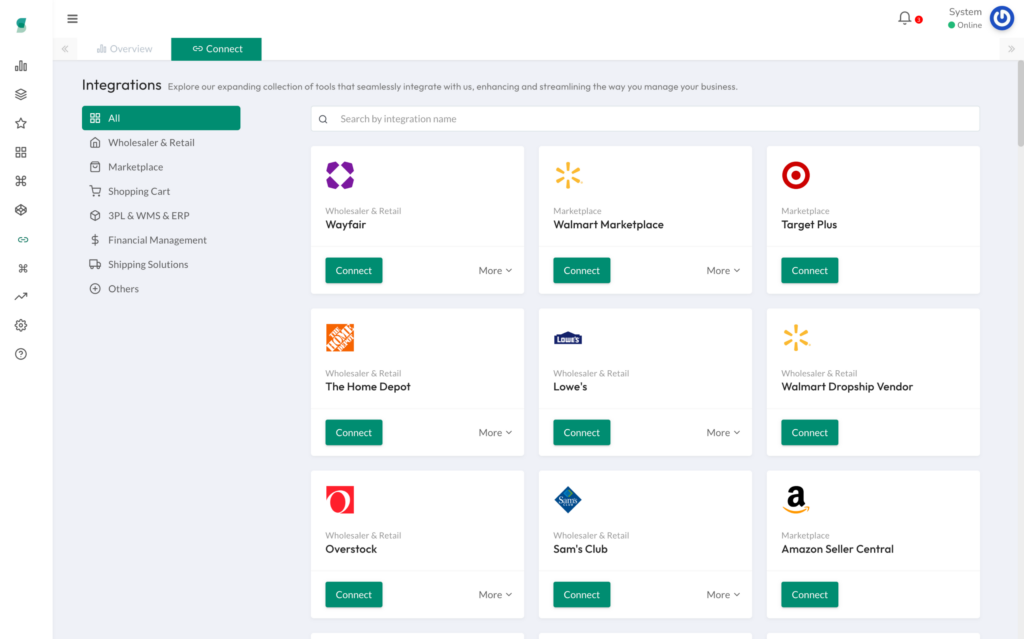
Inside Synctify ERP, sellers can manage multi-channel listings and inventory in one place—removing friction from channel selection.
👉 Want to learn more about us? 预订演示.
Subscribe to Our Newsletter
Get the latest releases, news and more!