

The 2026 U.S. holiday shopping season is starting earlier, and the latest data suggests October is becoming an increasingly important part of the year-end retail calendar.
According to Adobe Analytics’ 2026 holiday forecast, U.S. consumers are expected to spend a record $275.1 billion online during November and December, up 6.7% year over year.
But one of the more interesting numbers comes before the traditional holiday season even begins.
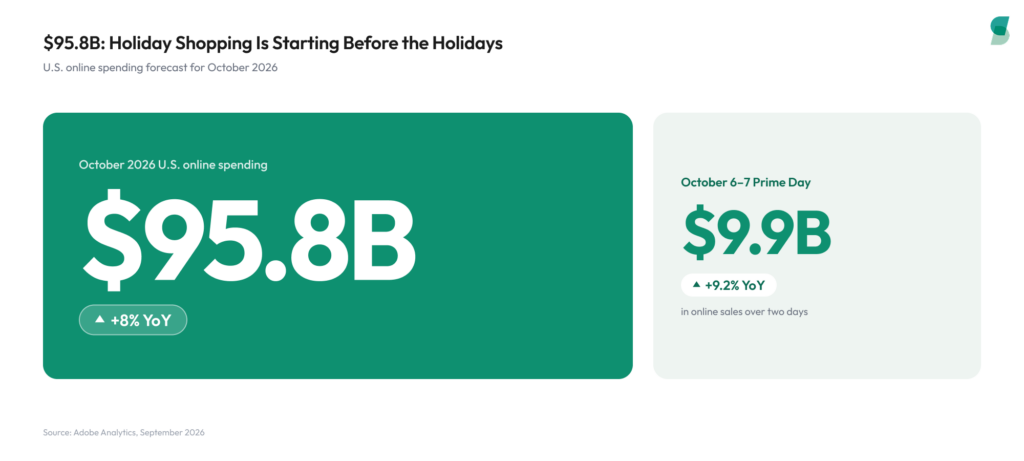
Adobe expects U.S. online spending to reach $95.8 billion in October, up 8% year over year. The October 6–7 Prime Day event alone is expected to generate $9.9 billion in online sales.
For U.S. sellers and retail suppliers, the takeaway is straightforward:
Holiday demand is no longer concentrated around Black Friday and Cyber Monday. Peak-season operations increasingly need to be ready by October.
When Does the 2026 U.S. Holiday Shopping Season Start?
Traditionally, the U.S. holiday shopping season has centered around Thanksgiving, Black Friday and Cyber Monday.
That timeline has been shifting.
Amazon’s October Prime Day has evolved beyond a single-marketplace promotion. Adobe describes it as an industrywide e-commerce event, with competing retailers launching promotions around the same period.
This year, online discounts are expected to reach as high as 19% during the October Prime Day period. Promotions will then continue into November, with discounts reaching as high as 30% during Cyber Week.
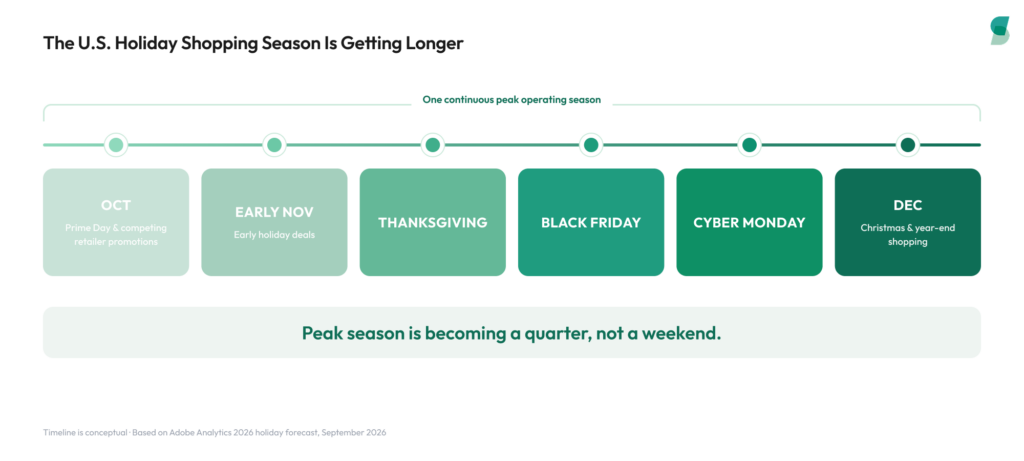
In practice, the 2026 holiday retail calendar looks less like a single peak and more like a series of overlapping demand periods:
October promotions → Early holiday deals → Thanksgiving → Black Friday → Cyber Monday → December holiday shopping
That gives consumers more opportunities to buy.
For retailers, sellers and suppliers, it also creates a longer peak operating season.
2026 U.S. Holiday E-Commerce Forecast: Key Numbers
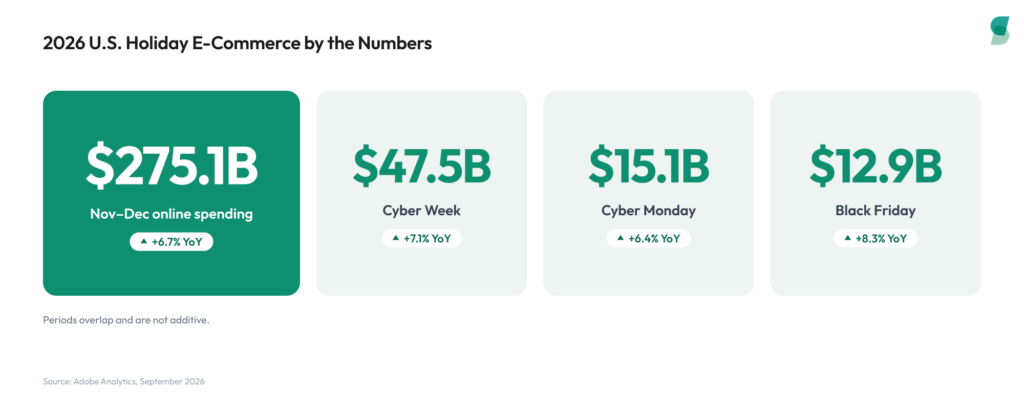
Adobe’s latest forecast highlights how large that extended season has become:
| Period | Projected U.S. online sales | YoY growth |
| October 2026 | $95.8B | +8.0% |
| November–December 2026 | $275.1B | +6.7% |
| Cyber Week | $47.5B | +7.1% |
| Black Friday | $12.9B | +8.3% |
| Cyber Monday | $15.1B | +6.4% |
Cyber Week will remain one of the most important periods of the year. But the broader trend matters just as much: retailers are competing for holiday spending well before Thanksgiving.
For operations teams, that changes how peak-season planning works.
A Longer Holiday Season Makes Inventory Planning Harder
When demand was concentrated around a smaller number of major shopping days, inventory planning had clearer milestones.
An extended promotional calendar creates more trade-offs.
How much inventory should be committed to October promotions?
How much should be held for Black Friday and Cyber Monday?
If the same SKU is sold through Amazon, Walmart, Target, a DTC storefront and other channels, how should available inventory be allocated?
And if one channel sells faster than expected, how quickly can inventory availability be updated everywhere else?
These become increasingly important questions for multichannel sellers.
The challenge isn’t simply having enough inventory. It’s maintaining an accurate view of what is available, where it is available and which orders have already committed that inventory.
During peak periods, even relatively small synchronization delays can lead to overselling, stockouts or unnecessary inventory buffers.
For Retail Suppliers, More Orders Create More Downstream Work
The operational impact looks different for suppliers working with retailer 1P programs such as Amazon Vendor Central or Walmart 1P.
An increase in purchase orders also creates an increase in the workflows that follow those orders.
Depending on the retailer and fulfillment model, suppliers may need to manage order acknowledgements, packing and carton information, shipment routing, Advance Ship Notices (ASNs), shipment updates, invoices, and retailer-specific compliance requirements.
Each step may have its own submission window and data requirements.
This is why peak-season scalability isn’t only about how many orders a warehouse can ship.
The systems connecting orders, inventory, fulfillment and retailer data also need to handle the increase in volume.
A manual process that works at normal order volumes can become much harder to manage when volume spikes across multiple channels at the same time.
Holiday Readiness Is Becoming an Operational Question
Consumer behavior is changing at the same time.
Adobe expects mobile devices to account for 57.4% of U.S. holiday online spending in 2026.
Traffic to U.S. retail websites from AI-powered shopping tools is also projected to increase 130% year over year during the holiday season.
Consumers are gaining more ways to discover products, compare options and shop across retailers.
Behind that increasingly fragmented customer journey, sellers still need a consistent operational layer.
Orders need to reach the right system. Inventory needs to stay synchronized. Warehouses and fulfillment partners need accurate information. Shipment updates need to return to the selling channel.
And for 1P suppliers, retailer-specific documents and data need to be submitted correctly and on time.
That’s why the more useful question heading into Q4 may no longer be:
“Are we ready for Black Friday?”
Instead:
“Can our operation keep orders, inventory and fulfillment synchronized from October through the end of the year?”
Preparing Multichannel Operations for the 2026 Holiday Season
For sellers and suppliers operating across multiple U.S. retail channels, four areas are worth reviewing before peak volume arrives:
Inventory visibility: Make sure available inventory can be updated across channels without relying heavily on manual adjustments.
Order centralization: Establish a consistent way to bring marketplace and retailer orders into the systems responsible for fulfillment.
Fulfillment synchronization: Ensure warehouse, ERP, WMS and 3PL workflows can exchange order and shipment information reliably.
Retailer compliance: For 1P programs, review how order acknowledgements, routing, ASNs, invoices and other retailer-required workflows are handled during higher order volumes.
The goal isn’t simply more automation.
It’s reducing the number of places where higher volume can create operational gaps.
As the U.S. holiday shopping season expands beyond Black Friday and Cyber Monday, peak-season readiness is becoming less about preparing for a few big shopping days and more about building an operation that can perform consistently for an entire quarter.
For multichannel sellers and retail suppliers, that may be the defining operational challenge of the 2026 holiday season.
Sources:
1. Adobe Analytics, U.S. Holiday Shopping Season to Hit Record $275.1 Billion Online, September 28, 2026.
👉 Want to learn more about us ? Book a demo with Synctify today.
Subscribe to Our Newsletter
Get the latest releases, news and more!