
Synctify has introduced a new Remittance Reconciliation feature to help suppliers and ecommerce finance teams review remittance advice, match payments to invoices, and resolve payment differences more efficiently inside Synctify.
For suppliers and ecommerce operators, getting paid is not always the end of the order journey. A single remittance advice may include multiple invoices, deductions, adjustments, or payment differences. When this process is managed across spreadsheets, emails, ERP exports, marketplace portals, and internal notes, reconciliation becomes slow, fragmented, and difficult to audit.
Why We Built Remittance Reconciliation
As suppliers expand across retail, marketplace, and external sales channels, payment data becomes more complex. Each channel may provide remittance information in a different format. Some payments match invoices cleanly, while others require manual review because of deductions, short payments, overpayments, or order-level adjustments.
For finance teams, this often creates recurring challenges:
- Payments are difficult to review in one place
- A single payment may reference multiple invoices
- Deductions and adjustments are hard to track consistently
- Payment differences require manual investigation
- Reconciliation reports take extra time to prepare
Synctify’s Remittance Reconciliation was built to help teams manage these issues in a more structured workflow.
What’s New: Remittance Reconciliation in Synctify
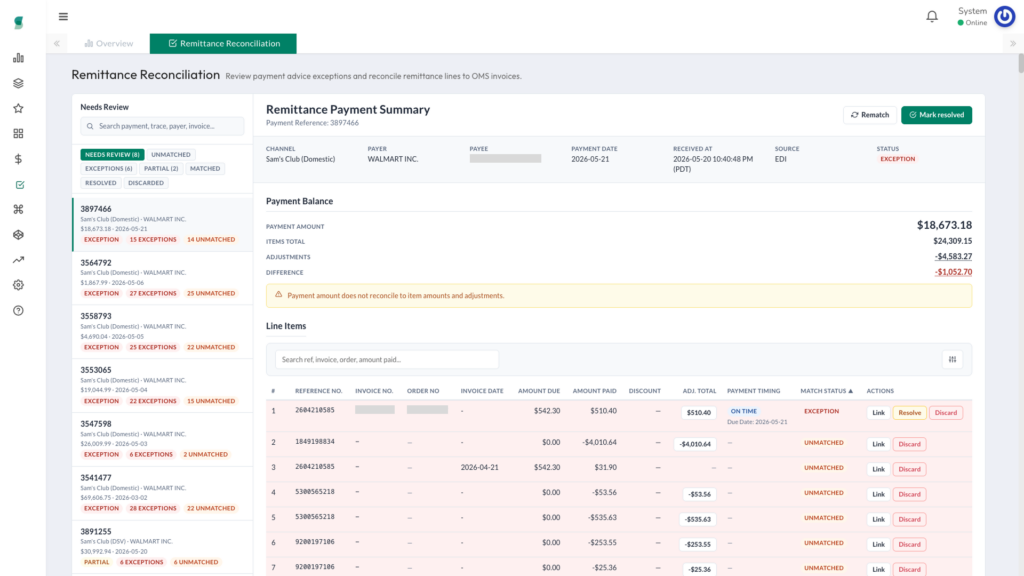
With Remittance Reconciliation, finance teams can review incoming remittance advice, match payment line items to OMS invoices or order adjustments, and resolve payment differences from one centralized workspace.
Instead of treating remittance review as a spreadsheet exercise, Synctify organizes payment advice into structured records. Teams can view payment details, line items, adjustments, references, attachments, and reconciliation status in one place.
Key capabilities include:
- Reviewing remittance advice from a centralized queue
- Checking whether payment line items are matched to OMS invoices
- Manually linking unmatched items to invoices or order adjustments
- Recording deductions and remittance adjustments
- Resolving underpayments, overpayments, and other payment differences
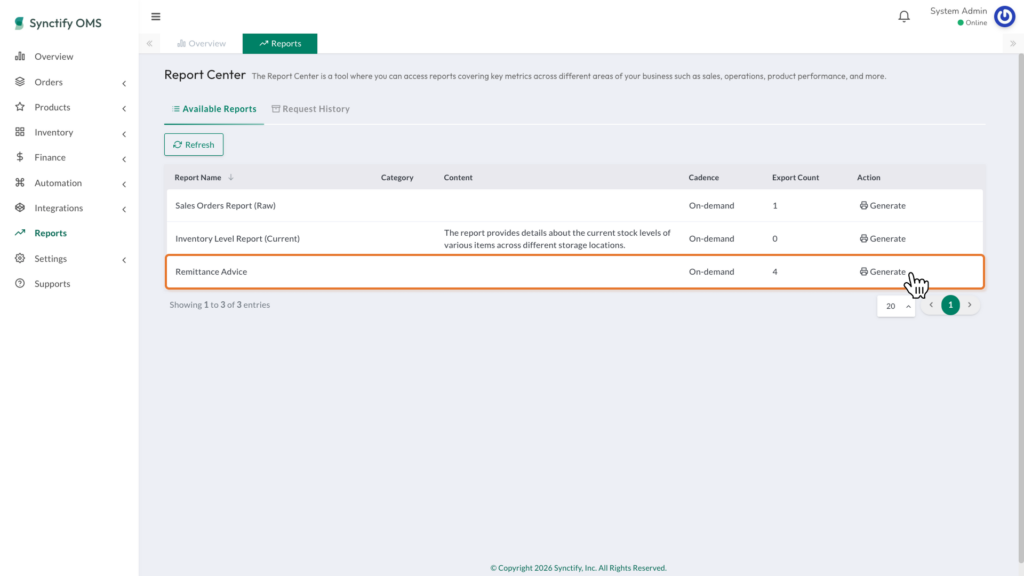
- Exporting remittance data as CSV or XLSX reports
- Marking a remittance as resolved after review is complete
For step-by-step instructions, visit the Synctify Support Center:
From Payment Data to Actionable Review
One of the main benefits of Remittance Reconciliation is that it gives finance teams a clearer way to manage payment review.
Each remittance record shows key payment information and line item status, making it easier to identify which payments are ready to close and which ones still need attention. Teams can filter and search by payment number, trace number, payer, channel, status, or match status instead of manually digging through large payment files.
This structure helps teams quickly answer questions such as:
- Which remittances still need review?
- Which line items are unmatched?
- Which payments include deductions or adjustments?
- Which differences were written off?
- Which balances still need to be collected?
Handling Deductions and Payment Differences
In retail and marketplace finance operations, payment differences are common. A paid amount may not match the invoice amount because of deductions, allowances, disputes, order adjustments, or other reconciliation issues.
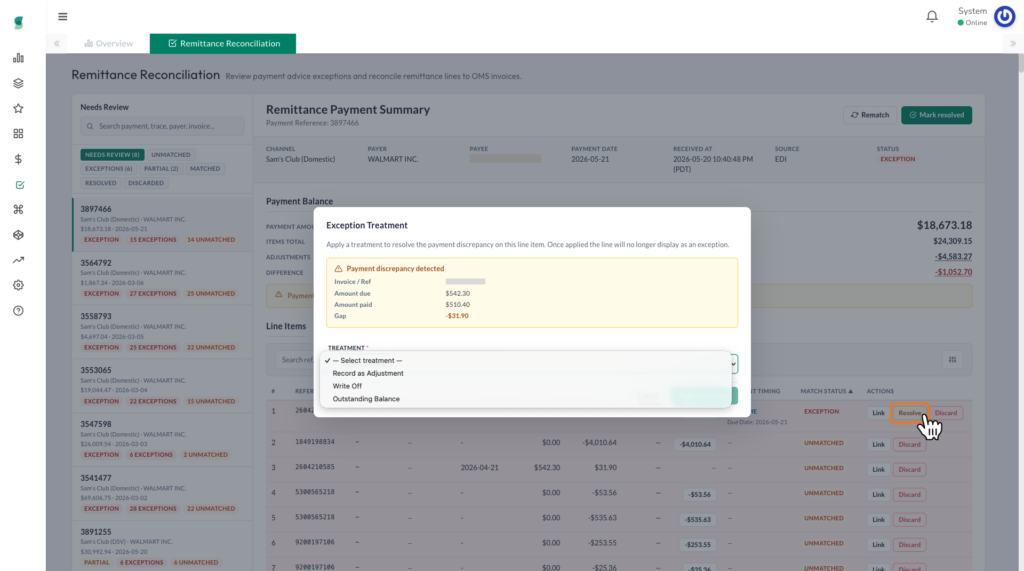
Synctify helps teams handle these differences in a more traceable way. If a line item cannot be automatically matched, users can manually link it to an invoice, connect it to an order adjustment, or record a deduction. If the paid amount does not match the expected amount, the item can be reviewed as an exception and resolved based on the team’s treatment decision.
This helps finance teams move away from informal notes and scattered spreadsheets toward a more organized reconciliation process.
Better Visibility Across Teams
Remittance Reconciliation is not only about closing payment records faster. It also improves visibility for finance, operations, and management teams.
Finance teams can track payment status and resolve exceptions. Operations teams can better understand whether order adjustments or deductions are affecting payment outcomes. Management teams can export reconciliation data for offline review, reporting, or internal analysis.
By keeping remittance advice, invoice matching, deductions, adjustments, exception handling, and reporting inside Synctify, businesses gain a more connected view of their post-order financial workflow.
When Should You Use Remittance Reconciliation?
Remittance Reconciliation is especially useful when your team needs to reconcile payments from a retail channel, marketplace, or external payment source against invoices or adjustments inside Synctify.
Common scenarios include:
- A payment includes multiple invoice references
- A payment line item cannot be automatically matched to an invoice
- The paid amount is different from the invoice amount
- A deduction or adjustment needs to be recorded
- A reconciliation report is needed for internal review or audit
Designed to Reduce Manual Work and Improve Control
For growing suppliers and ecommerce businesses, payment reconciliation can quickly become a bottleneck. The more channels you manage, the more payment records, deductions, and exceptions your finance team needs to review.
Synctify’s Remittance Reconciliation helps simplify that process by bringing payment review, invoice matching, deduction recording, exception handling, and reporting into one workspace.
To learn how to use the feature, visit the Synctify Support Center:
FAQ
blog-new-feature-remittance-reconciliation
Subscribe to Our Newsletter
Get the latest releases, news and more!