For many cross-border sellers, growth starts with marketplaces.
That is usually the right move. Marketplaces help sellers validate demand, generate early orders, and reduce the friction of entering the U.S. market. They are efficient, familiar, and often the fastest way to start selling.
But as a business grows, the question changes.
It is no longer only about how to get more orders. It becomes a question of how to build a business that is more durable, more recognizable, and less dependent on someone else’s rules.
That is where a brand-owned ecommerce site becomes important.
For sellers that want long-term growth in the U.S., a brand-owned ecommerce site is not a backup plan for “later.” It is one of the most important assets they can build.
Quick Answer: Should Cross-Border Sellers Build a Brand-Owned Ecommerce Site?
Yes, in most cases they should, but not always as the first step.
A marketplace helps you capture demand. A brand-owned ecommerce site helps you build long-term value.
It gives you more control over branding, customer relationships, merchandising, retention, and future growth. That does not mean every seller should rush to launch one immediately. It means that sellers who want to build a lasting position in the U.S. market should treat an owned ecommerce site as strategic infrastructure, not as an optional side project.
Why This Matters More in the U.S. Market
The U.S. is one of the most mature ecommerce markets in the world.
That maturity creates real opportunity. Consumers are used to shopping online, comparing brands, researching products, and buying across channels. For sellers, that means there is room not only to generate transactions, but to build repeat purchase behavior, direct demand, and long-term brand equity.
At the same time, competition is intense.
Many cross-border sellers end up in the same situation: they grow sales, but not brand recall; they gain marketplace traction, but not real customer ownership; they improve order volume, but remain highly exposed to platform fees, ranking shifts, and policy changes.
That is why a brand-owned ecommerce site matters more over time.
It gives sellers a place to turn transactional growth into owned growth.
Why Marketplaces Alone Are Usually Not Enough
Marketplaces still matter. In many cases, they are the best first channel for testing demand and entering a new market quickly.
But marketplaces are designed for conversion efficiency, not necessarily for business ownership.
You can win orders without owning the customer
When customers buy from a marketplace, they usually remember the marketplace first.
You may fulfill the order and deliver a good experience, but the platform still controls much of the customer journey. That makes it harder to build direct relationships, shape post-purchase communication, segment customers effectively, and drive repeat demand back to your own brand.
In other words, marketplaces help you transact, but they do not always help you accumulate customer equity.
Marketplace growth can become increasingly fragile
As sellers scale on marketplaces, structural costs usually rise with them.
Commissions, ads, fulfillment, promotions, compliance requirements, and operational overhead can all expand as revenue grows. More importantly, those rules are not yours to control.
That means growth can become increasingly dependent on a system you do not own.
When one channel carries too much of the business, risk concentration grows with revenue.
Brand building needs more than a listing page
Some products can sell from a simple listing page. Many cannot.
Higher-consideration products often need more education, comparison, trust-building, and storytelling. Customers may want to understand how a product works, who it is for, how it compares, and why the brand is credible.
A marketplace listing can help close demand that already exists. A brand-owned ecommerce site helps create and strengthen demand that lasts.
What a Brand-Owned Ecommerce Site Really Does for Cross-Border Sellers
Many sellers think of an owned ecommerce site as just another channel. That is too narrow.
Its real value is that it helps turn operating effort into owned assets.
It becomes your brand home
On a marketplace, your business lives inside someone else’s framework.
On your own site, you control the narrative. You decide how products are introduced, how pages are structured, what proof points are emphasized, what content supports conversion, and how the brand is positioned.
That matters if you want customers to remember your brand name, not just the platform where they found you.
It helps you build first-party customer assets
A strong owned ecommerce site allows you to learn from customer behavior in a way that marketplaces usually cannot fully support.
You can better understand where visitors come from, what they browse, what they add to cart, where they drop off, what they repurchase, and how they should be segmented.
These are not just analytics questions. They are the foundation of retention, lifecycle marketing, product education, and customer value expansion.
It improves resilience
A brand-owned ecommerce site does not replace marketplaces overnight.
But it gives you another growth path, one that is more closely tied to your own brand, your own content, and your own customer relationships.
That matters because resilient businesses do not rely on one environment alone. They create multiple ways to attract, convert, and retain customers.
It creates compounding value
Marketplace spend often behaves like rented attention.
When ads stop, traffic slows. When promotions end, visibility drops.
An owned ecommerce site creates the possibility of compounding returns through content, branded search, direct traffic, email capture, repeat purchase, and accumulated customer familiarity.
That is why mature brands do not treat their ecommerce website as a temporary experiment. They treat it as infrastructure.
| Core Data Dimension | Third-Party Marketplaces (e.g., Amazon) | Brand-Owned Site (DTC) | Strategic Business Value |
| Customer Contact Info (Email / Phone) | Limited (Restricted to single-order fulfillment) | 100% Brand-Owned | Email marketing, lifecycle campaigns, and building an owned audience. |
| Full Behavioral Tracking (Clicks / Bounces) | Data is owned and siloed by the platform | Fully Trackable (via Pixels, GA4) | Pixels, GA4)Optimizing conversion funnels and executing precise retargeting ads. |
| Purchase History & Customer LTV | Partially available; difficult to attribute | Fully Accumulated | Customer segmentation, VIP tiering, and high-value customer retention. |
| Zero-Party Data | Nearly impossible to acquire | Acquired via surveys & interactions | The ultimate differentiator to prepare for the era of AI-agent shopping. |
When Should a Cross-Border Seller Build a Brand-Owned Ecommerce Site?
The right timing depends on business stage.
Not every seller needs to launch one immediately.
You should build one sooner if
You want to build a recognizable brand in the U.S.
You sell products with a longer consideration cycle.
You already validated demand on marketplaces.
You want stronger repeat purchase and retention.
You want to reduce dependence on a single platform.
You may wait if
You are still testing product-market fit.
Your pricing or fulfillment model is unstable.
Your team does not yet have content or growth capacity.
You only want a site because competitors have one.
The hardest part of an owned ecommerce site is not launching it. It is operating it consistently.
Without content, traffic strategy, conversion work, and retention systems, a site can remain a brochure instead of becoming an asset.
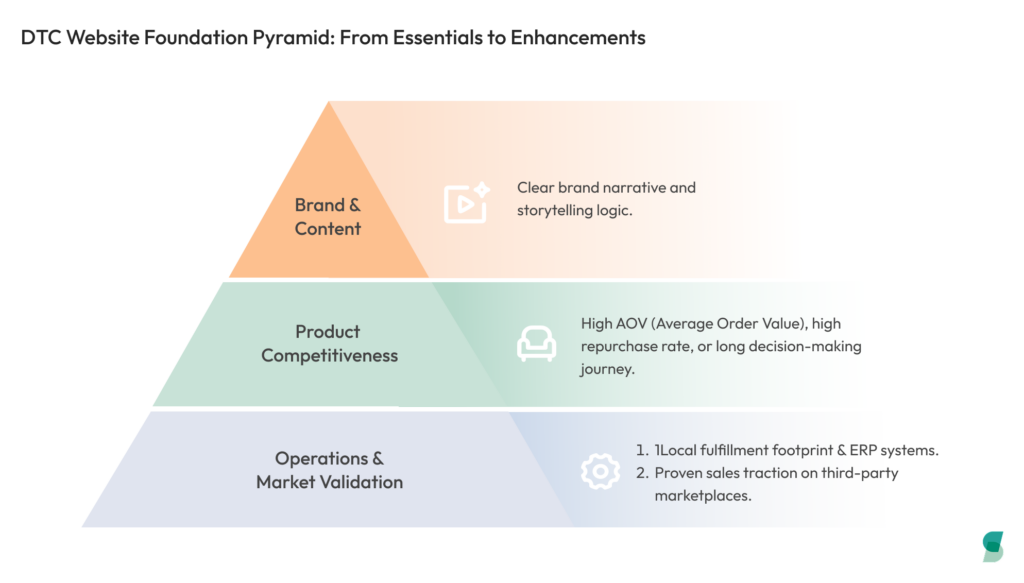
Marketplace First, Brand-Owned Ecommerce Site Second Is Often the Best Path
For most cross-border sellers, this is not an either-or decision.
The better path is usually simple: use marketplaces to validate demand, then use your brand-owned ecommerce site to build durable value.
A marketplace is strong at capturing ready-to-buy demand. An owned ecommerce site is strong at supporting brand search, content-driven discovery, repeat purchase, and direct customer relationships.
That combination is often much stronger than relying on either one alone.
Shopify vs BigCommerce vs WooCommerce: Which Platform Is Right for Your Brand-Owned Site?
Once a seller decides to build a brand-owned ecommerce site, the next question is usually platform choice.
The right choice depends less on which platform is “best” and more on which one fits your current stage.
Shopify: best for speed, simplicity, and fast execution
Shopify is usually the easiest path for brands that want to launch quickly with less technical friction.
It is a strong fit if you want a fast go-live timeline, a mature ecosystem, straightforward backend management, and lower operational complexity for a lean team.
If speed and operational simplicity matter most, Shopify is often the most practical starting point.
BigCommerce: better for brands planning more complexity
BigCommerce usually becomes more attractive when the business is moving toward more complexity.
It is a good fit if you expect multiple storefronts or regional structures, more advanced catalog or pricing logic, B2B requirements in addition to B2C, or a stronger need for native extensibility.
If your future operating model is likely to become more layered, BigCommerce may be a better long-term fit.
WooCommerce: best for flexibility, content depth, and control
WooCommerce is attractive when content, search, and control are central to your growth strategy.
It is a strong fit if you want more control over site structure, a content-heavy or SEO-heavy model, greater implementation flexibility, and a site that functions as a long-term brand platform.
The tradeoff is that it usually requires more technical management and maintenance discipline.
| Operational Dimension | Shopify (Fully Hosted SaaS) | BigCommerce (Enterprise SaaS) | WooCommerce (Open-Source / Self-Hosted) |
| Speed to Market & Ease of Use | Very Fast: Easiest path to launch with the most mature app ecosystem. | Moderately Fast: Quick setup but tailored to accommodate more complex business logic. | Slower: Steeper learning curve; requires a strong technical background to build and configure. |
| Customization & API Flexibility | Lower: Predictable monthly subscription; platform handles hosting and security updates. | High: Highly open APIs designed to support complex architectures and integrations. | Extremely High: Full code-level autonomy; you control 100% of the site structure. |
| Setup & Maintenance Costs | Lower: Predictable monthly subscription; platform handles hosting and security updates. | Moderate: Monthly subscription; built for scalable growth with fewer hidden tech costs. | Higher: Requires paying for your own servers, hosting, and often a dedicated IT or developer team. |
| Best Suited For (Ideal Stage) | Brands needing fast market validation and seamless omnichannel rollouts | Sellers requiring multi-storefront management or complex B2B/B2C pricing structures. | Tech-forward teams wanting 100% control over content, SEO, and long-term site infrastructure. |
How to Choose Between Shopify, BigCommerce, and WooCommerce
Ask these questions:
Do you need speed, or deeper flexibility?
Will your business become more operationally complex in the next 12 to 24 months?
Is content and SEO a meaningful growth channel for you?
Does your team have the technical resources to support a more customizable setup?
If speed matters most, Shopify is usually the easiest starting point.
If scale and operational complexity matter more, BigCommerce may be stronger.
If content, SEO, and control matter most, WooCommerce can be the better long-term choice.
Who Benefits Most from a Brand-Owned Ecommerce Site?
A brand-owned ecommerce site is especially important for sellers in these situations.
Brand-led sellers
If your goal is not only to sell products but to build branded demand, direct recall, and repeat engagement, you need an owned destination.
Sellers with higher-ticket or more considered products
Furniture, home goods, functional products, outdoor products, and specialized categories often require more explanation and trust-building than a marketplace listing alone can provide.
Sellers already succeeding on marketplaces
If you already have marketplace traction, the next step is not always to add another marketplace. Often it is to start owning more of the customer journey.
Sellers trying to reduce platform dependence
If changing marketplace costs, rules, or customer ownership limitations are already creating pressure, an owned ecommerce site is not a nice-to-have. It is a strategic hedge.
FAQ : Brand-Owned Ecommerce Site Strategy for Cross-Border Sellers
blog-brand-owned-ecommerce-site-strategy
Final Takeaway
For cross-border sellers, the real question is not whether a brand-owned ecommerce site can generate orders.
It is whether you want to keep building on rented ground, or start building an asset you actually own.
If your goal is short-term sales only, marketplaces may be enough for now.
If your goal is long-term growth in the U.S. market, with stronger brand positioning, better customer ownership, and more resilience, then a brand-owned ecommerce site is not a backup plan.
It is one of the most important assets you can build.
Want to turn marketplace growth into a more scalable multi-channel operation?
Synctify helps sellers connect channels, orders, inventory, and operational workflows across major marketplace, retail, and shopping cart environments, so growth becomes easier to manage across platforms.