

As brands move through the first quarter of 2026, most ecommerce and retail teams are deep into planning the next big push: mid-year campaigns and, more importantly, the 2026 holiday season. Before you lock in budgets and channels, it’s worth taking a clear look back at how U.S. ecommerce actually played out in 2025, especially over Black Friday and Cyber Week.
By now, the key U.S. ecommerce 2025 statistics are in: market share estimates, holiday sales totals, and platform-level shopper behavior. In this article, we focus on two questions operators care about most:
- Who really owned U.S. ecommerce in 2025?
- During Cyber Weekend 2025, where did shoppers actually go to buy?
Two charts answer both questions and give you a benchmark for your own 2025 performance—and a baseline for planning the rest of 2026.
Who really owns U.S. ecommerce in 2025?
If you zoom out and look at U.S. retail ecommerce market share in 2025, the picture is more concentrated than many people assume.
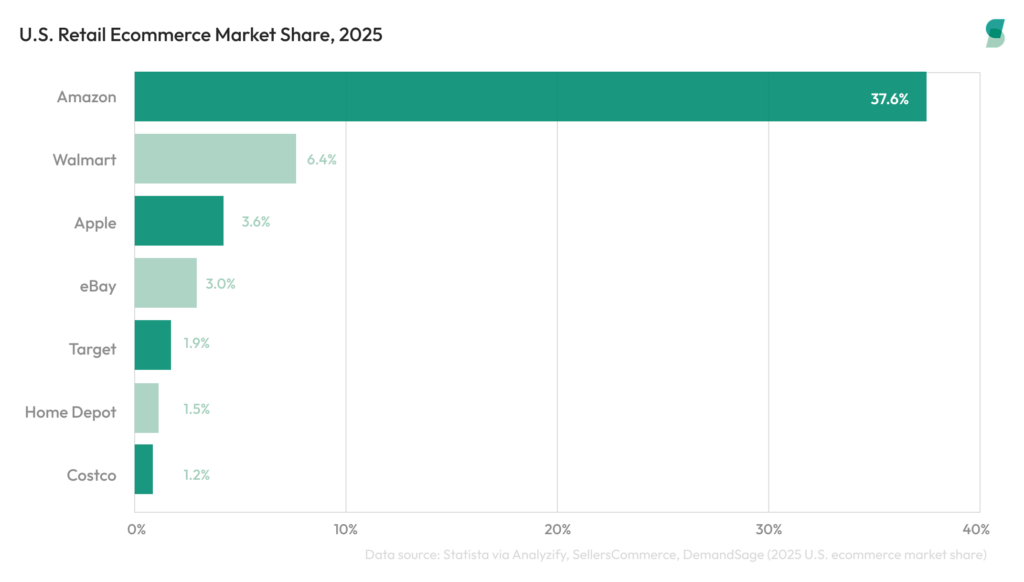
Recent estimates suggest that in 2025, Amazon captured roughly 37.6% of U.S. retail ecommerce sales. Walmart followed at about 6.4%, Apple at 3.6%, eBay at 3.0%, and Target around 1.9%. Home Depot and Costco each sit in the low single digits as well. In other words, one platform controls well over a third of online sales, while the rest of the field fights over relatively modest slices of the pie.
From a strategy standpoint, this matters for two reasons:
- First, when you talk about U.S. ecommerce 2025, you’re not talking about a flat, evenly distributed marketplace—you’re talking about a landscape where Amazon is the default starting point for a huge portion of online spend.
- Second, the other major retailers—Walmart, Target, Home Depot, Costco—still play critical roles, especially in omnichannel journeys, but they’re structurally smaller online and often need to be treated as complementary channels, not equivalents.
For your own business, this chart should prompt a simple audit:
- How much of your 2025 online revenue came on or through Amazon?
- How does that compare to your performance on Walmart, Target, or direct-to-consumer?
- And is that mix aligned with where the market actually spent money last year?
Cyber Weekend 2025 statistics: where shoppers actually shopped
Market share tells you who usually gets the money. Holiday-period behavior tells you where shoppers run first when the deals go live.
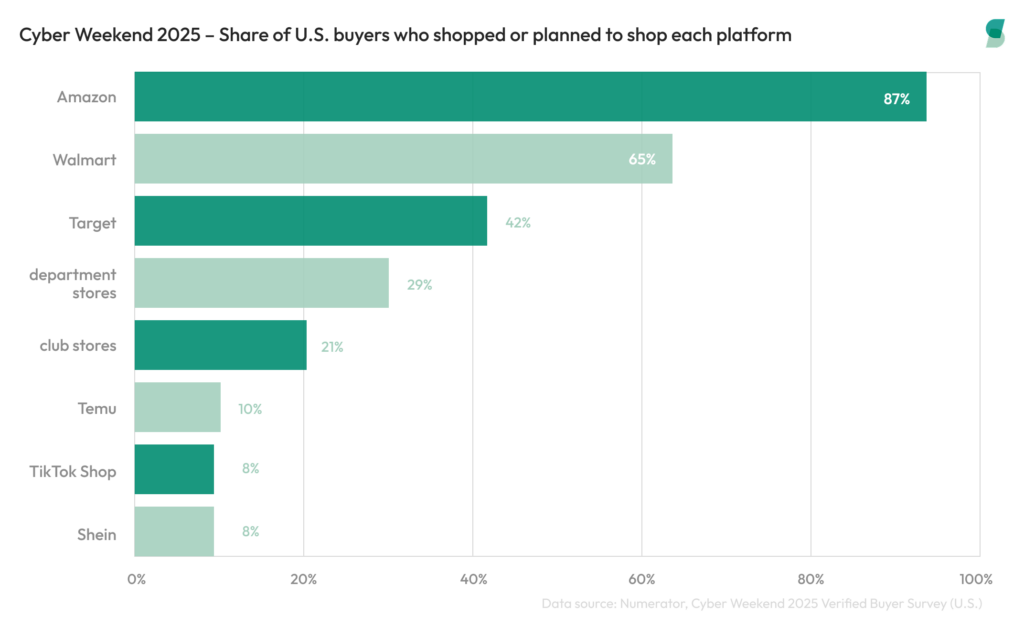
Survey data from Cyber Weekend 2025 (Thanksgiving through Cyber Monday) shows just how skewed shopper behavior really was:
- 87% of U.S. buyers shopped or planned to shop on Amazon
- 65% shopped or planned to shop on Walmart
- 42% did so on Target
- 29% visited department stores
- 21% visited club stores (e.g., Costco, Sam’s Club)
- Newer, high-buzz platforms reached much smaller shares: Temu(10%), TikTok Shop(8%), Shein(8%)
This tells a different but related story:
- In peak season, Amazon isn’t just the largest marketplace—it’s the default tab in almost every shopper’s browser.
- Walmart and Target are clearly the next tier of “must-have” channels for U.S. shoppers during Black Friday and Cyber Week.
- Temu, TikTok Shop and Shein, while noisy in the media, still behave more like early-stage incremental traffic sources: important, fast-growing, but not yet primary destinations for the majority of U.S. holiday buyers.
If you look back at your own 2025 Black Friday and Cyber Week performance, ask yourself:
- Did your traffic and revenue mix roughly mirror this platform reach, or were you over- or under-indexed on certain channels?
- Were you treating emerging platforms like Temu, TikTok Shop and Shein as core battlegrounds, or as experimental incremental channels alongside an Amazon- and Walmart-led core?
Using 2025 to calibrate your 2026 plans
By March 2026, the 2025 holiday season isn’t “news” anymore—but it is your most recent, fully measured reality.
These two charts—U.S. ecommerce 2025 market share and Cyber Weekend 2025 platform reach—give you a clean baseline. They show who really owned demand last year and where shoppers actually showed up when it mattered most.
So before you finalize your 2026 channel strategy and Black Friday plan, pause on one simple question:
👉 Did 2025’s results line up with what you expected—on Amazon, on other marketplaces, and on emerging platforms?
If the answer is “yes”, your 2026 plan is about scaling what already works.
If the answer is “not really”, the gaps between your numbers and these benchmarks are exactly where your next round of experiments should start.
Subscribe to Our Newsletter
Get the latest releases, news and more!